1994 - Page 3
Ollerton Was Closed 1994, After 69 Years
- Continued -
  Captain Montagu Wright, aged 26, a member of the Wright family who were Directors of the Butterley Co had replied to an advert in the ‘Colliery Guardian’ magazine requesting suitable candidates for interview for a Colliery Manager’s position in the ‘new coalfield’. He was set on as Manager by Henry Eustace Mitton, on 5th May 1922, because after returning from the War wounded, having served in the Tunnelling Corps, and had had experience in the Survey, Mechanical and Electrical departments previously, and then having passed his Managers’ Certificate, had experience in mechanisation at Kirkby and then was a Shotfirer at Hartshay for 6 months. He was never a Deputy, Overman or Undermanager which was the general way of promotion to Manager but his family were Directors of the Company. However he would turn out to be a good Manager and liked by all. Monty resided firstly at the Hop Pole Hotel in the old village and attended work every morning at 7am to observe the progress and consult with the men. Billy Jenkyn and Ernest Revill were asked to encourage 40 to 50 men to the new pit and were able to achieve better as around 70 applied for jobs. Captain Montagu Wright, aged 26, a member of the Wright family who were Directors of the Butterley Co had replied to an advert in the ‘Colliery Guardian’ magazine requesting suitable candidates for interview for a Colliery Manager’s position in the ‘new coalfield’. He was set on as Manager by Henry Eustace Mitton, on 5th May 1922, because after returning from the War wounded, having served in the Tunnelling Corps, and had had experience in the Survey, Mechanical and Electrical departments previously, and then having passed his Managers’ Certificate, had experience in mechanisation at Kirkby and then was a Shotfirer at Hartshay for 6 months. He was never a Deputy, Overman or Undermanager which was the general way of promotion to Manager but his family were Directors of the Company. However he would turn out to be a good Manager and liked by all. Monty resided firstly at the Hop Pole Hotel in the old village and attended work every morning at 7am to observe the progress and consult with the men. Billy Jenkyn and Ernest Revill were asked to encourage 40 to 50 men to the new pit and were able to achieve better as around 70 applied for jobs.

Ollerton Hall
Montagu Wright (1124) the Manager moved into Ollerton Hall vacated by John Baker JP, Land Agent to Lord Savile from 1917. The main offices were allocated there originally.
The very first load of Ollerton Brights was delivered to John Baker by cart and horse, and the first coal to leave the pit by rail was hauled by LNER engine number 6413 from the Tuxford depot on 1st September 1926 and the train load was delivered to Coote and Warren, St Ives, Huntingdon. The engine driver was Edward Hutchinson, Fireman Charles Fox and Guard Joseph Pickering. In wagon No BC 1612, 13 tons 8cwt gross weight, tare 5 tons 18 cwt and Nett weight 7 tons 10 cwt of handpicked best brights. The second wagon was LNER 75371, 15 tons 1 cwt, tare 6 tons 9 cwt and nett weight 8 tons 12 cwt of handpicked hards. The first wagon was a Butterley Co one and the second a London and North Western truck, Butterley Loco driver was Harry Dunn of New Ollerton, Shunter was Harold Baxter of Ompton. Wagon Weighman was Samuel Shepherd of Sutton and Screen man was Wilfred Berridge of Sutton also. The Manager was Montagu Wright, Undermanager John Elliott and Enginewright Horace Searson. This coal must have been produced during August because it is known that when the 1926 strike was beginning to fold many miners began to return to work from mid August onwards.
The Company also made sure that the workforce was happy with their surroundings as men were set on from Derbyshire, Nottingham and Staffordshire mainly and were integrated in the New Ollerton mining village.
A miners’ Welfare was built where men could get a drink, play cards, billiards etc, and it was used for dances, concerts, weddings and other special occasions.
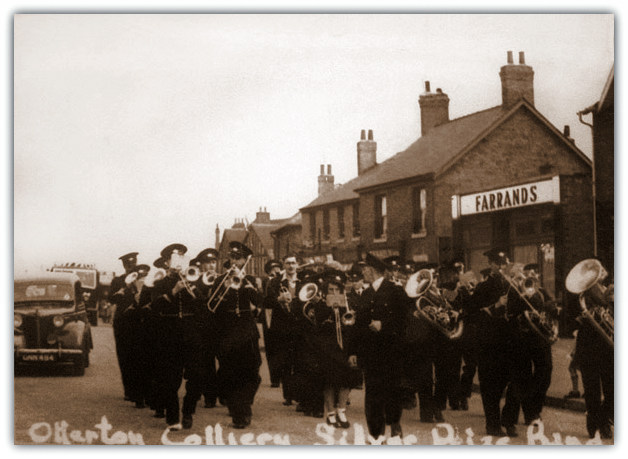
Adjacent was a Band Stand for the Silver Prize band and surrounding that was a Skating Rink.

There was a Football field and Cricket pitches were laid out on the sports ground off Whinney Lane and inter-colliery competitions were arranged and in particular a Tug o’war contest and Boxing matches.

The Ollerton teams were quite successful over the years and the respective Managers were very pleased and generally sat with the victorious teams showing off the cups won, as seen in the photo. Bowling greens, Tennis Courts were also laid out.

The Colliery St John’s Ambulance Brigade was popular and there was Nursing Cadets for the girls. Other activities comprised Boy Scouts and Girl Guides as well as Boy’s Brigade, Jazz Band, a Male voice Choir, Mothers’ Union, and a Coal Queen was chosen at the yearly Gala. Trips to the seaside were arranged and were popular with the train from the local station being packed.
The village became almost self-sufficient as shops were built along Forest Road and anything from ‘the Butcher, the Baker to the Candle stick maker’ was available including a Post Office, Paper shop, General store where one could buy anything from ‘a pin to an elephant’ as the saying goes and a Dentist’s surgery. A Cinema was opened and a weekly Newspaper printed and affectionately referred to as the Penny Liar. There was a Nurse or Midwife and also an Undertaker. Two Churches were built, St Paulinus for the Anglicans and St Joseph’s for the Roman Catholics. There was also a Methodist Chapel. Schools were built for the children and to start with there were too many children and some were sent as an overflow to a school in the Old Village beyond the Village Church down Wellow Road A weekly bus service, originally a conversion from the Green Grocer’s lorry could take interested parties to Mansfield or other towns as a treat. An electrical therapy clinic was opened on Forest Road as it was thought that such treatment would help the miners who had back problems or such and get them back to work quickly.
Butterley Co Director Captain Fitzherbert Wright opened the temporary Miners’ Institute, a corrugated tin hut in July 1924. It was situated at the junction of Forest Road and Sycamore Avenue. The Mission Hut was built later.
Bill Lickey one of the miners’ leaders arranged a meeting regarding setting up a Sick and Accident club, with a fee of 1s (5p) a week.

Ollerton Families
Further housing was built later by the Council and the CIHA (Coal Industry Housing Association) to accommodate the influx of miners mainly from the North East attracted to Ollerton and the new sinking at Bevercotes and in the late 1990s the area covering Old Ollerton and New Ollerton would evolve from a village to be a Town called Ollerton under Newark and Sherwood district and have an elected Mayor. The Town Hall was a conversion of a pair of semi-detached houses on Sherwood Drive.
In the late 1980s this was opened as a Physiotherapy Clinic and I was able to assist a long time friend and neighbour Sue Parkin to gain the position of Physiotherapist by furnishing a reference to the NUM union.
A Doctors Surgery opened adjoining the house on the Church Circle. In later years a Library was opened and in the late 1970s a Rugby team was founded by Gordon Weeks, Assistant Undermanager at the mine.
A Bookies Office was situated on Rufford Avenue at the side of the ‘black pad’ a walkway through to the pit from the village sooner than walking up the pit lane after in became legal. There would be someone in the village who would be an illegal ‘Bookies runner’; no doubt.

At weekends they put seats in the van and used it as a bus
A public house, the Plough had been built on Forest Road. The Jolly Roger club would open near to it later. I believe there was Chip shop down towards the Boughton end of the New Ollerton village.
No dogs were allowed in the village before 1943 probably as a deterrent against Whippet racing or Hare coursing. Also around this time walking on the front lawns previously resulting in a fine as mentioned previously was finally withdrawn when it was found that soldiers billeted in the village during the Second World War were playing cricket on them and the Company had no jurisdiction over them so they relented. Pigeon fanciers and racing was tolerated.
A band of clay was found on the site and a brickwork factory erected on the site, the kiln costing £15,000. The output was 500,000 bricks per month. In the 1940s the brickworks chimney would have to be strapped up to prevent it shattering due to undermining, and constant checks were made by the Surveyors to note the tilt etc.
In 1932 coal cutters were introduced on 2 districts, the first machine drivers being, Hill, Vickerstaff and Walker and by 1934 all panels were cut by machine, the coal loaded into tubs in the main gates. 26” (0.66m) face conveyors were installed, the norm for face conveyors at the time being 20” (0.50m) wide. At first 500 to 600 tons a shift was the aim but this increased quickly to 750 tons and later 1,000 tons a shift was achieved.
By 1933 some of the men were requesting to leave the pit and move to other collieries such as Mansfield Crown Farm nearer to towns where the women folk could obtain work, as at that time there was no industry at Ollerton. The company awarded £15,000 towards the clothing factory of Earl and Hall of Leicester built on Newark Road.
In 1934 a major check survey was done as it was found there was some error in the plotting of the Working plan. I similarly check surveyed by theodolite and catenary measuring the whole of the pit in every open roadway starting at the shafts in 1971-1972 having found gross errors in the plotted position of some roadways on the standard mine plan sheets requiring me to construct some new sheets and amend other areas by annotations regarding the accuracy of the workings. |


