1994 - Page 27
Annesley Bentinck Mothballed

Annesley Bentinck, colliery (South Nottinghamshire), (merged in March 1988), was closed on 12th February 1994 after 127 years and ‘mothballed’, and put on care and maintenance.
 Annesley was sunk from 1st Jan 1865-1867 by Worswick and Co, of Coleorton in Leicestershire. Annesley was sunk from 1st Jan 1865-1867 by Worswick and Co, of Coleorton in Leicestershire.
Shaft positions: SK55South West No1 shaft 451773,353287, No2 shaft 451724, 353278. Shafts 13 feet dia (3.96m) No1 deepened to Deep Hard at 649 yards (593m) in 1914 at 17 feet (5.18m) dia.
The ventilation fan was a single inlet Aerex fan with a 8 feet (2.38m) dia driven by a 550hp motor at 740 rpm.
Bentinck was sunk 1894-1896 by the New Hucknall Colliery Co.
Manpower 565 u/g /126 s/f, plus 220u/g /43 s/f private contractors.
- Bentinck No1 43/4854/740983 was filled and capped Dec 1988
- Bentinck No3 shaft 43/4854/799974 was filled and capped Aug 1990
- Bentinck No2 shaft 43/4854/769969 filled and capped Dec 1992.
- The Bentinck adit was kept open for coal production from Annesley, co-ordinates SK 448990, 355065.

Both pits were in No4 Area of the NCB in 1947, transferred to South Nottinghamshire Area in 1967, then to Nottinghamshire Area in 1986.
120m of water-bearing strata had to be sunk through and the water which was held back by cast iron tubbing.
The shafts were brick lined below this.
The steam winders were changed to electric and double deck cages used on both shafts with accommodation for 12 men on the bottom deck at No1 and 2 decks for 14 men each at No2 shaft.
The old part of the shaft at 13’ 0” (4.0m) dia was continually being widened out to 17’ 0” (5.2m).
At one part near the Top Hard horizon an old roadway was found behind the shaft brickwork that was not plotted on the working plan. The Surveyor George Simms (5618) surveyed the discovery and amended the working plan. HMI was informed.
Annesley - Seams worked:
- Top Hard 1867-1921
- Deep Soft 1914 - and 1921-1981-1983
- Deep Hard 1914-1950 and 1980s
- Tupton accessed via drifts from Deep Soft- 1950, 1974/78/79-1986
- Blackshale 1982-1994. No1 shaft section: High Main 4’ 0” (1.23m) at 228 yards (208m)
- Low Bright 2’ 7” (1.19m) at 374 yards (342m)
- High Hazles 2’ 2” (0.67m) at 406 yards (371m)
- Coombes 2’ 1” (0.63m), Top Hard 4’ 0” (1.22m) at 477 yards (436m)
- Dunsil 1’ 9” (0,53m) at 496 yards (453m)
- 1st Waterloo 1’ 11” (0.58m), bat 11” 0.28m), 2’ 2” (0.67m), Deep Soft 3’ 0” (0.91m) at 617 yards
- Deep Hard 3’ 2” (0.96m) at 635 yards (581m).
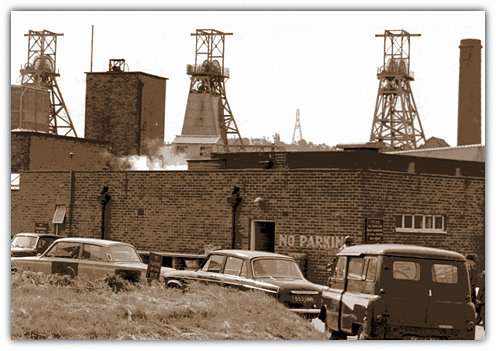
Bentinck
The first checkweighman appointed in 1880 was Aaron Stewart (another from Leicester) who checked the amount of coal produced by weighing the tubs at the surface which determined the wages of the men on ‘piece work’ by the Butty system. He played a leading part in the formation of the Nottinghamshire Miners’ Association (NMA) which was formed in 1881 when he became the full time secretary until 1909, dying in 1910 aged 65. Contract prices for getting hand holed coal filled out by screens (or forks 1” between the tines) in 1919. No small coals, bats or dirt such as bind or stone was to be loaded out and severe penalties were taken such as non-payment if a tub was found to contain such for the collier was able to be identified by the tub numbered from a particular stall. An allowance of a shilling (5p) a shift was paid if working in water or wet conditions.
The lease taken out by the Worswick Co ended in 1904 when the Hardwick Colliery Co took over the running of the pit and Chambers of that company reorganised the pit and arranged for the shafts to be deepened in 1914 from the Top Hard to the Deep Soft horizon. The New Hucknall Colliery Co purchased the mine in 1925 but found that the colliery was in a poor state and had been badly under invested to improve production etc. An aerial ropeway transported dirt to the tip where there was a McLane conical tip.
Reorganisation 1953-1955 36” (0.91m) trunk conveyors and gate belts, 300 ton Crawley storage bunker in pit bottom and 200 ton bunker on 2s Main belt road. 2 ton capacity mine cars, 2 on each of the 2 deck cage wound at No1 shaft to 1981. In 1958 new covering around No2 UC pit top and a new heapstead in 1961.
The ‘Annesley system’ of panzer-mounted swan-necked jib cutting machines and hand filling was an early mechanisation success previously to shearers being introduced in 1963.
A surface store was built in 1961/63.
A new coal prep plant was built by Blantyres with a throughput of 200 tons per hour that lasted until 1981 when all the coal production was diverted underground through a thirling roadway to Bentinck Colliery in the Blackshale seam.
Diesel locos for materials had been introduced in 1967 and for manriding in 1968.
There were several firedamp ignitions at the face when the top turret of DECMT struck a thin quartz layer intrusion in the seam, fortunately with no injury.
 No1 Electric winder Dec 1968, No2 summer 1969 for materials and men. No1 Electric winder Dec 1968, No2 summer 1969 for materials and men.
Undergound booster fans were introduced at Deep Soft South East drift in 1972.
A new boiler house in 1973.
A new main surface fan was operational in 1975.
A Waffler cutting machine was introduced in 1975 and a Trepanner in 1977.
A new pit bottom loading point was put to work in 1977 using mine cars.
A new administration block was built in 1976 and a new stores building in 1984.
2 cross measures 1in5 drifts were driven to the Tupton from the Deep Soft seam and the Deep Hard was re-opened by cross measures drifts from the Deep Soft in 1981.
The Blackshale was accessed from the Deep Soft also by drifts in 1983.
Due to No2 shaft having problems with shaft clearance to the cages and also deterioration of the shaft brickwork it was decided to widen the shaft to 4.7m over 225m to which would in turn increase the ventilation flow desired. Widening of the top part of the shaft was carried out periodically.
 Following the underground thirling connection to Bentinck the coal preparation plant was dispensed with as all the run of mine product including Newstead coal via another connection was now sent through to and raised up Bentinck 1in4 surface drift and washed at the coal prep plant there. Following the underground thirling connection to Bentinck the coal preparation plant was dispensed with as all the run of mine product including Newstead coal via another connection was now sent through to and raised up Bentinck 1in4 surface drift and washed at the coal prep plant there.
A Waddle fan for ventilation was introduced in 1934, with 144” (3.65m) dia single inlet exhaust, 163,000 cfm at 7.4” (0.19m) w.g. (water gauge) driven by a 450 hp Crompton Parkinson synchronous motor with rope drive giving a fan speed of 310 rpm.
A canteen was opened in 1946 followed by pithead baths for 1,152 men in 1947.
An aerial ropeway introduced in 1948 for dirt disposal to the tip was replaced by lorries taking spoil to the Newstead tipping area in 1967.
A medical centre was opened in 1955.
The coal prep plant dealt with 200 tons/hour.
Maximum output of 620,609 tons was in 1970/71, whereas in 1964/65 the output was 450,080 tons. The manpower in 1972 was Face men 358, Elsewhere below ground (EBG) 371 and surface (s/f) 201 giving a total manpower of 930.
Additional ventilation was effected by an underground booster fan at K90s.
Following the abandonment of the Deep Soft and the Tupton seams a reorganisation was carried out in the 1980s all production was concentrated in the thick 3 leaf Blackshale seam which was up to 7 feet (2.15m) thick.
All the pit’s production records were broken in November 1992. Blackshale 83s retreat panel cut 21,460m, 13.34 miles, highest weekly advance of 41.9m with 74 cuts to produce 40,037 tonnes. 85s advancing face produced over 20,000 tonnes to give an overall pit output record of 61,000 tonnes. The highest daily output 8,657 tonnes, record cutting distance of 4,640m (2.88 miles). The week’s output produced the cheapest coal since the pit was sunk.

Manriding was by top and bottom conveyor in the 1in7 intake drift some 650m. In the Blackshale there was a further top and bottom belt conveyor manrider in K80s return gate for a distance of 460m. Manriding outbye was by top belt conveyors to the 1in7 drift. In the Deep Hard and Tupton seams loco haulage from pit bottom inbye some 1,680m to Deep Hard and a further 1,380m to the Tupton end. The Tupton manrider up the drift was 3 x 24 seater covered-in cars endless haulage for 800m. Outbye manriding was by traditional top belt conveyors.
Underground locos: 2’ 1” gauge:
- 2 x 0-6-0 DMS 100hp HE 1965
- 0-6-0 DMF 100hp HE 1966
- 0-6-0 DMF 100hp HE 1974
Supplies transported by 100hp Hunslet diesel loco for 3,060m and then endless rope haulage up the panel gates. A pump lodge at K66s delivered water via No1 shaft to settling ponds and then delivered by a surface pipe line to the River Trent in 1989.
|


