Tempest Hit The Dewsbury Area
Storms Of Great Severity hit District
Violent thunderstorms broke over Dewsbury on Sunday afternoon and the rain came down in torrents, accompanied by vivid flashes of lightning and loud peals of thunder. The weather then cleared, and the remainder of the afternoon was fine. Rain however fell again during the night, and on Monday afternoon, the day before the colliery disaster, the storm was repeated with even greater severity, and was of much longer duration.
The rain was so heavy that in a short time the streets became flooded, the drains being quite insufficient to carry away the water. In the Market Place, as usual in times of heavy rain, the cellars under the shops became flooded, most of them to a depth of six feet, and the water also got into some of the shops, covering the floors. Fortunately the shopkeepers had taken the precaution to remove any stock that was of value from the cellars, so that no material damage was done beyond the inconvenience of removing the water and cleaning the place out.
In Watergate, the water, which rushed down Daisy Hill, forced its way into the foundry of Messrs Newsome Sons and Spedding, and the works had to be stopped in consequence. It also ran in at the front door of the Anchor Inn, and right through at the back, flooding the various lower rooms and the cellars.
Twenty Inches Of Water In Halifax Road
A very curious sight was witnessed in Halifax Road on Monday as a vast quantity of rushed down Willans Road, a large proportion of which found its way into the gardens of the dwellings constituting what was, two hundred years ago, Dewsbury Hall. The dirty fluid covered the gardens to the depth of about twenty inches and then ran out through and under the wooden shops fronting Halifax Road, in quite a considerable stream.
Mr Tweedale's Gardens
In Moorlands Road, as local readers know, is one of the boundary walls of Mr Tweedale’s ornamental grounds and behind these, at the south-east end, water accumulated and forced masonry down for many yards.
Higher up in Boothroyd Lane, where lofty new walls have been built for him by the Corporation, large breaches were made, the stonework giving way through the outward thrust of the mass of water rolling down the south-west side of the meadow known as Birkin Bank.
Some damage was done by the flood in the New Public Pleasure Park, but the portion of the Crow Nest Estate devoted to the coming show of the Yorkshire Agricultural Society appeared to be little affected by the violent storm.
FUNERAL OF A VOLUNTEER — Yesterday, the remains of ex-Staff-sergeant Hirst were interred at Dewsbury Cemetery. The deceased was one of the oldest members of the Dewsbury Rifle Corps, joining on the nomination of the late Joshua Ellis, Esq. He was a good shot, a good comrade, and a good man. For many years, and up to the time of his death, he was the landlord of the Sir Robert Peel Inn, Bradford Road.
ACCIDENT IN WORKSHOP — On Thursday, about six pm, Jonathan Clifton, aged 46, of Southill Terrace, Dewsbury, was engaged at Messrs J. Smith and Sons, dyers and cleaner, Hartley Street, Dewsbury, in fixing some water pipes in the out-dyehouse, when an accident occurred. It resulted in five of his finger ends being taken off and he was removed to the District Infirmary, and amputation was performed.
Thunderstorms On Second Day Of Funeral
Never To Be Forgotten Scenes In Churchyard
Long Line Of Hearses And Mourner's Coaches
Distressed Widows Borne Away From Graveside
110 Interments
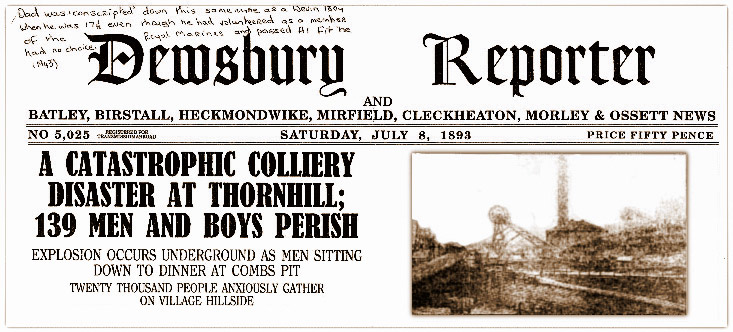
The usually quiet and peaceful God's Acre surrounding the ancient parish church of Thornhill was again the scene of a sad spectacle, never to be forgotten by those who witnessed it. It was a sight, the like of which was never before beheld in this district, and, it is to be hoped, never will be again. We allude, of course, to the interment of the large number of men and boys who fell victims to the awful catastrophe which took place at Thornhill Combs on Tuesday when 139 men and Boys lost their lives by the frightful colliery explosion which took place.
About a score had been buried on the previous day, and it was expected that the mournful work would be resumed today. Of those who died, 110 were consigned to their resting places in the Thornhill Churchyard, the remaining 29 being buried in other villages.
Ten hearses and about forty cabs, provided by Mr E.T. Ingham the owner of the ill-fated colliery, arrived at that hour. But it was found to be too early for those of the deceased residing at a distance, to be in readiness. There was a thunderstorm in the morning which caused some delay, and it was five minutes to twelve when the first body, that of Isaac Lightowler (36) arrived at the Thornhill Churchyard gates. His widow and mother headed the mournful procession.
Hymns Sung At The Graveside
While the burial service was being conducted, the solemn strains were heard of the "Dead March” played by the Thornhill Brass Band, which is chiefly composed of miners. The band also accompanied to the graveside the body of Tom Senior, who was a trombone player with them. During the afternoon two other prominent members of the band, Drum-major Senior, who has been connected with the band for many years, and Firth, the tenor horn player, were interred. The band headed the procession in each case. Two other funerals which aroused considerable interest were those of Charles and Aquilla Booth of Thornhill Edge. The latter was the organist at Thornhill Edge Church, and Charles was the choirmaster of the same place of worship. The choir from Thornhill Edge Church, and also the choir from Thornhill Church, sang several beautiful and appropriate hymns at the grave side of the two men, who were also active members of the Thornhill Glee Society.
The officiating clergy were Archdeacon Brooke, of Halifax, formerly rector of Thornhill; the Rev F.R. Grenside, rector of Thornhill; the Rev. W.l. Brooke, the Rev G. Wheelhouse, curate- in-charge of the Good Shepherd, Thornhill Edge; the Rev J. Hamilton, vicar of Middlestown, the Rev. H. Walshaw How, vicar of Mirfield. One funeral was conducted by the Rev. Fr. Edwin Carr, of St Joseph's Mission, Batley Carr, and three or four by the Rev. J. Wilkinson, Primitive Methodist minister, Horbury. Amongst the funerals conducted by the last named were those of George Milnes (51), Thornhill Edge, and his two sons, Benjamin (22) and James (17). A short service was held at the Primitive Methodist Chapel, Thomhill Edge, after which the corpses were conveyed to the churchyard, and the service at the grave was read by Mr Wilkinson.
Tears Of Sympathy In Many Eyes
With regard to Benjamin Milnes, it will be remembered that he was to have been married on that very day to Miss Jessop, a young woman living in the village. The cab which was to have conveyed the wedding party had been ordered a month previously, and little did the unfortunate young lady think at that time, that instead of being led from the alter a joyous bride, she would be following the remains of her beloved to the grave. It was indeed a touching scene, and brought tears of sympathy to many eyes.
With melancholy, regularity, the funeral processions arrived at the churchyard all day, right until nearly nine o'clock at night when the last of the 110 interments took place. During the dreadful day many other distressing scenes were witnessed, especially in the case of families who had lost their sole bread-winners, and many a poor widow had to be borne away from the grave supported on each side by strong men.
The manifestations of grief, seen on every hand, were enough to melt the hardest and most callous to tears, and during the whole of the afternoon thousands upon thousands of spectators assembled. As they were not permitted to enter the churchyard, they took up positions in the roadway in the vicinity of the entrance porch, and behind the boundary walls of the graveyard.
There was constantly a long line of hearses and mourning coaches, extending for a considerable distance on each side of the entrance gate. The mourners were all respectably attired in black, and carried flowers. Most of the coffins were also covered with wreaths. The remainder of the bodies were interred at the following places:- Sixteen at Whitley, three at the Baptist Chapel Churchyard, Thornhill, one at Dewsbury, one at Flockton, one at Middlestown and one at Outwood.
A Quiet Day At Thornhill Following Funerals
Men Coming Seeking Jobs At Combs Pit
Thornhill was very quiet on Sunday, the day following the funerals, but there were still some Thornhill was very quiet on Sunday, the day following the funerals, but there were still some visitors from neighbouring places, Barnsley and the Spen Valley, as well as Dewsbury, including men looking for work at the colliery. Many of the people went to the Parish Churchyard and watched the extra sextons filling up and trimming the numerous new graves, upon which wreaths of flowers were laid, together with a few bouquets. Many bore cards with inscriptions, simply "Goodbye, Jack," and a sadder one still which read - 'The last present to my beloved husband." Some of the visitors were relatives of the dead which was easy to see from their saddened tearful faces.
Among the men who came to Thornhill that day were some that sought employment at the pit. But, until the inquest is concluded, and arrangements made, nothing could be done for them. It is stated that Mr. E.T. Ingham, the proprietor of the colliery, was much pained by these early inquirers. He has not forgotten those who are gone, among whom were many old servants. Mr Ingham has always been a favourite amongst his men, whom he generally addressed by their Christian names. His kindly feeling was heartily reciprocated. If the colliery is started again, many of those who from time to time have found a home elsewhere, will hopefully come back. On Monday one of the survivors declared that he would go back to Combs Pit when he was better, if they would set him on again.
Her Majesty And The Sufferers
Telegram Of Sympathy
 During Tuesday afternoon when news of the catastrophe had spread like wildfire, there were people in the crowds who wondered whether the Queen knew of it, and more than one was heard to say that if she did she would feel very grieved and would be sure to send a message. In the afternoon a telegram was received from the Home Secretary, Mr Asquith, and read as follows:- "I am instructed by Her Majesty to express her deep sympathy and condolence with all the sufferers from this terrible catastrophe, and her desire that all particulars may be furnished her as soon as possible." During Tuesday afternoon when news of the catastrophe had spread like wildfire, there were people in the crowds who wondered whether the Queen knew of it, and more than one was heard to say that if she did she would feel very grieved and would be sure to send a message. In the afternoon a telegram was received from the Home Secretary, Mr Asquith, and read as follows:- "I am instructed by Her Majesty to express her deep sympathy and condolence with all the sufferers from this terrible catastrophe, and her desire that all particulars may be furnished her as soon as possible."
Great satisfaction was expressed when this was exhibited and became known to the people. Other telegrams were received throughout the day, including one from Dewsbury's Member of Parliament, Mr Mark Oldroyd, which reads: "Profoundly regret to learn the sad news. Pray add my name to the Relief Committee. Trust further search shows disaster much less serious. — M. Oldroyd.
Mr Oldroyd, who is also head of the Dewsbury woollen mills, Mark Oldroyd and Sons, is keeping in daily touch, by letters and telegrams, with the Relief Committee, who have set about raising funds for the widows and orphans left behind through this terrible catastrophe. The day after the calamity, he wired this message to the Chairman of the Relief Committee.
"Dear Sir, — I wired you last night on receipt of your telegram announcing the sad catastrophe at Combs Colliery, Thornhill. In the case of a disaster so appalling one feels helpless, if not paralysed. I gather from the papers this morning the melancholy news that there is no hope whatever of rescuing any of the unfortunate men who were in the mine at the time of the explosion. Under the circumstances, the only thing one can do is to minister relief to those who will indirectly suffer from the calamity. I am glad that the Local Board have so promptly begun this work, and I hope and believe that a substantial sum will be raised for those widows and orphans who are called upon to endure the dreadful calamity of losing those nearest and dearest to them, and upon whose labours they have hitherto been dependent. I shall be glad to subscribe £100 to the proposed fund. With profoundest sympathy for the bereaved, believe me, yours truly, M Oldroyd.
Items Of News
ANOTHER OUTBREAK OF SMALL-POX Last night three cases of small-pox from one house at West Vale, Dewsbury, were admitted into the local infectious hospital.
THEOPIUM TRAFFIC—A petition against the opium traffic, signed by 1,450 of the inhabitants of the Parliamentary Borough, has been presented in the House of Commons by Mr. Mark Oldroyd, M.P. for Dewsbury.
FAILURE OF PUBLICAN — Yesterday, a petition in bankruptcy was filed at the Dewsbury County Court, by Mr. F. Dwyer, solicitor, on behalf of George Gough Taylor, late of the Queen's Head Inn, Westgate, Dewsbury.
|