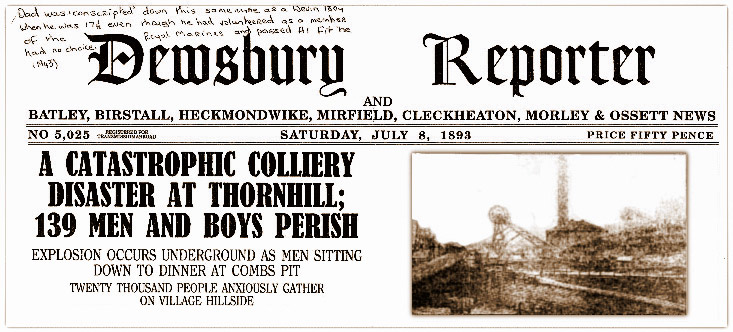
In Loving Memory of the 139 Men and Boys
who lost their lives in the
Thornhill Colliery Disaster
July 4th, 1893
Fifty years have passed away,
Since disaster came to the Thornhill mine;
Thornhill men with their lives did pay,
Their number, one hundred and thirty nine.
It was on July fourth in ninety-three
They went to work with hearts so gay;
None of them knew what their fate would be
Before the close of the day.
They got their picks and and molts and lamp
And took their turn for the cage;
No thought had they that fire damp
Would turn their lives' last page.
Down the pit they made their way,
Upon their trams up to the face,
Where danger lurks to take its pay
From workers of the mining race,
With their picks they did attack
The coal, to win and fill;
When it comes to getting diamonds black
Someone's got to pay the bill.
Their work went on much as before,
None knew that disaster was in store;
The bill was paid, 'tis sad to say,
By Thornhill men that very day. |

Photograph of 113 miners from Combs pit taken in the 1920s — some 30 years after the disaster. It was taken at a time when miners were becoming more militant and it is almost certain that there will be pictured among them men who lost relatives and friends in the Combs disaster. The picture was kindly loaned by Mr Pickles, of Thornhill, whose father, the late Mr Herman Pickles, is pictured standing far top right in a flat cap. |
Death Of Two Survivors
We regret to inform you that two of the men who were rescued alive from the pit have since expired after lingering in great weakness from Wednesday night. Joseph Heywood, of Middlestown, did not sufficiently recover to be taken home, and remained in the shed where he and the others were taken when they were brought out of the pit. Joshua Ashton, another of the survivors, succumbed early this morning (Thursday).
Heywood was most assiduously attended to by the doctors and a trained nurse to the last, but no hopes were entertained of his recovery and he gradually grew weaker.
A Female Swindler And The Catastrophe
A woman named Elizabeth Sutcliffe (22), described as a dressmaker, of Dale Street, Leeds, was charged on remand at the Bradford Borough Police Court, with attempting to obtain charitable subscriptions by means of false pretences.
The allegation against her was that she had taken advantage of the Thornhill colliery disaster to solicit subscriptions from charitable people, with the intention of devoting the proceeds to her own uses.
In the course of her visits she called upon a Mrs Stephenson, of 88 Leeds Road, who recognised her as the same women who had previously solicited, without authority, subscriptions ostensibly for the Nutter Orphanage.
She had no authority to collect for the sufferers by the Thornhill disaster, but it was
found by a book in her possession that she had collected about £4. The prisoner, who pleaded guilty, was also shown to have been many times in the hands of the police since the year 1875,
The Stipendiary Magistrate (Mr Skidmore) severely reprimanded the prisoner for her conduct, and ordered her to be imprisoned for three months.
Subscriptions Through The Press
We have received, and have paid over to the treasurer of the Relief Fund, one shilling, the gift of "a working man". Also five pounds, the donation of Messrs George Jessop and Son, clothing manufacturers, Batley. Yesterday we received three shillings from Mr George F. Shaw, of Leeds.
Any further contributions sent through the Reporter for the Relief Fund will be duly acknowledged by us in this column. What is intended to be done should be done quickly.
Owner Of Colliery In Ireland As Disaster Occurs
Sobs Like A Baby On His Return - Donates £1000 to Widows And Orphans
The owner of the colliery, Mr Edward Theodore Ingham, of Blake Hall Mirfield, a gentleman, whose experience of mining is unsurpassed and who operates all his collieries on the best principles, was in Ireland when the calamity occurred. A telegram despatched immediately to him on Tuesday was not received until around two o'clock, but travelling difficulties caused the anguished gentleman hours of delay and he did not arrive at the pit until half past four o'clock the following afternoon. Mr Ingham, whose father opened Combs Colliery thirty five years ago, shortly after the Crimean War, arrived at Dewsbury just as some of the dead miners were being brought to the surface. Despite his weary and sorrowful state, he joined the next rescue party going below and stayed at the pit until four o'clock in the morning when all hope of finding any survivors seemed lost. On Thursday, looking tired and weary, Mr Ingham joined a meeting of local businessmen and members of Dewsbury Corporation with the purpose of forming a Relief Committee to provide a source of income for the many pitiful widows whom the calamity had deprived of their only breadwinner. He made an immediate donation of £l, 000.
Stoutest Heart Would Quail
Mr Ingham, speaking under the influence of great emotion, described in detail the conditions under which he had received the telegram announcing the terrible disaster. This memory would remain with him for the rest, of his life, and neither could he ever forget the sights which awaited him at Thornhill. They had been enough to make the stoutest heart quail. He was indebted, and would be forever, to the courageous and admirable rescuers who had risked their lives for their fellow men. They had indeed done a noble service. Mr Ingham, recounting his state of mind on that day and on the following day when he arrived back in Dewsbury, said he had received the telegram informing him of the calamity just as he was sitting down to luncheon, which was being served later than usual. He immediately obtained a horse and vehicle but found that the train started at ten minutes past three from Limerick and he had only forty-eight minutes in which to get there. The best black mare on the road could only cover the distance in fifty minutes, therefore he had to give up the attempt to catch the train. It had been absolutely impossible to be at the station in time, for the train, being a mail train, started punctually, which meant he could not leave Limerick until eleven that evening.
Colliery Owner Sobs Like A Child
He got information on Wednesday the best way he could and each telegram seemed to be worse than the one before. He arrived in Thornhill about half-past four o'clock, and his arrival under such circumstances was enough to have made the stoutest heart quail. Mr Ingham continued that on the way back to Dewsbury he could not help feeling as if it did not matter one bit about the colliery. All the time he was in the train he could feel the words "widows and orphans" ringing in his ears. He was completely upset. He said he did not leave the pit till between two and three o'clock in the morning, and when he went home for the night he could hardly stand.
He said that he could now tell the committee that every inch of the pit had been explored, and that he knew exactly how many men had been involved. He said there would be 138 bodies, with nine men having been brought out, one of whom had expired and another being seriously ill and he believed the return was accurate, for the figure had been obtained from the number of lamps found and by other means. Mr Ingham visibly moved and unable to contain his emotions, said he would work on the Executive Committee as much as ever they wished him to do so, but he begged them not to ask him to go into all the individual cases. At this point he broke down sobbing and members of the committee spontaneously and sympathetically signified their desire to spare him any unnecessary pain. Mr Ingham composed himself and proceeded to explain that the mine had been very slightly damaged, and if the men had been there to work the mine, it would have been possible to start work again on Monday morning as if nothing had happened. He added that whenever the secretary wanted the money he could draw upon him (Mr Ingham) to the extent of £1,000. He only hoped that the bereaved could be helped through. At the conclusion of his address, Mr Ingham completely broke down, and sobbed like a child, with his head in his hands.
Respectful Sympathy
One of the members, Mr Lipscomb, said he remembered Mr Ingham's father sinking the Combs Pit, and ever after that, it had been set out on the very best principles, regardless of cost. Nothing that skill, energy and capital could accomplish to make the pit safe had ever been spared. From that time to this he (Mr Lipscomb) had never heard that the mine was conducted on any other but the safest principles, and he thought this ought to be known. People who did not know anything about collieries were apt to think when a great disaster occurred that some precaution ought to have been taken by the proprietors, which had not been taken. There was no ground for any such allegation in the present case, and there was nothing to be done but to bow to this dreadful dispensation. He tendered to Mr Ingham, on accurate, for the figure had been obtained from the number of lamps found and by other means. Mr Ingham visibly moved and unable to contain his emotions, said he would work on the Executive Committee as much as ever they wished him to do so, but he begged them not to ask him to go into all the individual cases. At this point he broke down sobbing and members of the committee spontaneously and sympathetically signified their desire to spare him any unnecessary pain. Mr Ingham composed himself and proceeded to explain that the mine had been very slightly damaged, and if the men had been there to work the mine, it would have been possible to start work again on Monday morning as if nothing had happened. He added that whenever the secretary wanted the money he could draw upon him (Mr Ingham) to the extent of £1,000. He only hoped that the bereaved could be helped through. At the conclusion of his address, Mr Ingham completely broke down, and sobbed like a child, with his head in his hands.
Respectful Sympathy
One of the members, Mr Lipscomb, said he remembered Mr Ingham's father sinking the Combs Pit, and ever after that, it had been set out on the very best principles, regardless of cost. Nothing that skill, energy and capital could accomplish to make the pit safe had ever been spared. From that time to this he (Mr Lipscomb) had never heard that the mine was conducted on any other but the safest principles, and he thought this ought to be known. People who did not know anything about collieries were apt to think when a great disaster occurred that some precaution ought to have been taken by the proprietors, which had not been taken. There was no ground for any such allegation in the present case, and there was nothing to be done but to bow to this dreadful dispensation. He tendered to Mr Ingham, on behalf of the whole room their most respectful sympathy.
The Chairman moved that it should he placed on record in the minutes that the committee expressed their sincere sympathy with Mr Ingham. The motion, which was supported by the Mayor of Dewsbury, was seconded by Mr Lipscomb, and was unanimously agreed to. The Chairman turned to Mr Ingham and told him he had their sympathy. Mr Ingham replied that he knew he had and said he wanted to thank all the mining engineers and gentlemen who had been helping them during the last two or three days. They have done noble service and what every Yorkshireman always liked to do for another.
The chairman remarked; "It makes a man proud of his countrymen to stand at the pit and in such circumstances as those on Tuesday evening and to see them risking their lives for the sake of others." Members agreed to form a sub-committee to inquire into the cases of hardship among the bereaved and it was decided to make an appeal to corporations and local boards to open subscription lists. This concluded the proceedings and a meeting of the Executive Committee followed.
Tragic Tale Of New Born Daughter
The youngest child left without a father after the dreadful Thornhill calamity was little Georgina Fenton, of Prospect Terrace, Thornhill, who was born two weeks before the terrible event. Her father George Fenton, whom she was named after, also left a widow, Sophia, and two other children, Ada and Ernest.
Georgina was to grow up and experience a life of great suffering. She had ten children, and named one, George, after the father she had never known. Tragically this son was also killed in a mining accident at Denby Dale Colliery fifty years later. He was 28 and engaged to be married. Her husband, Leonard Pickles, was also a miner and he died from chronic bronchitis caused through coal dust.
|