1982 - Page 4
Bretby Tunnelling Machine Trials At Cadley Hill

The first pit to attempt to tunnel to 18 feet (5.5m) dia using the Bretby Tunnelling machine was Cadley Hill (South Midlands) in 1982, the boom-in-shield setting pre-cast concrete segments. The best advance was 35 yards (32m) with an average of 13 yards (12m) per week.
Strawberry Knob and Rice Hill
The Low Main seam was developed at Mansfield. A huge tipping complex for the three pits in the group, Mansfield, Clipstone and Rufford (North Nottinghamshire) was centred about Strawberry Knob. ‘Rice Hill’ the original McLane tip at Mansfield was covered in trees to the Forest Town side and the tip could be seen from many miles away. Several attempts to reduce the tip and extract small coals would be resisted in future years, (however in 2003 the diggers moved in and the small coal extracted and the hill disappeared!)
Extraction of Barium
At Bevercotes (North Nottinghamshire) there was a plant for dealing with the extraction of barium from pumped mine-water.
Welfare Football Team
Go To Wembley
Rainworth Welfare football team (Rufford) lost by 3 goals to 2 in the final of the FA Vase at Wembley.
North Derbyshire
New coal preparation plants were commissioned at Bolsover (£4m) and Renishaw Park (£6.6m). A 4th drift was being driven at High Moor (North Derbyshire).
Monopolies And Mergers Commission Advisors Visit Ollerton
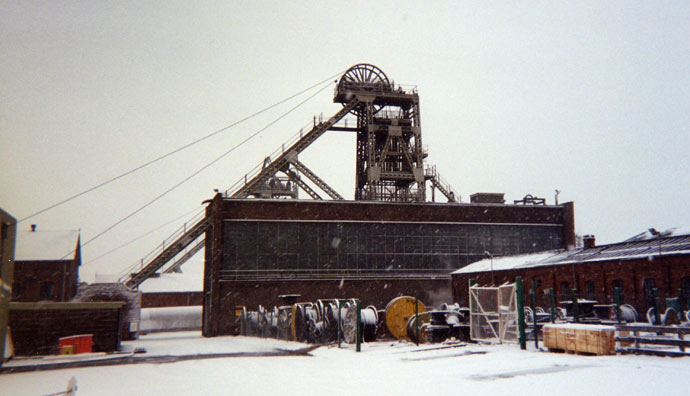
Professor J Shaw and Mr JS Marshall Advisors to the Monopolies and Mergers Commission visited Ollerton (North Nottinghamshire) on 19th August 1982. Profit for 1981-1982 had been £10.7m equating to £10.30 per tonne of saleable coal produced. Although one of the most productive pits in the country a check was made to ensure the large amounts invested in the colliery were realistic. The production came from the Parkgate seam at about 750m deep with a working temperature of around 27ºC that was expected to increase as the workings advanced inbye to the dip. Air-cooling equipment was installed and further installations were planned.
Around 80% of the output went to the CEGB for electricity generation at the River Trent-side power stations, the balance for concessionaires, inland domestic markets, Ireland, Homefire Plant Keresley, Coventry and the Ollerton Rexco plant.
The cost of the latest advancing face using an Anderton Strathclyde Double ended ranging drum shearer and Dowty 4 leg x 300 tonne powered supports, Dosco Side discharge road machines and cam packers, plus all the electrics and associated loading equipment such as AFC drives and 120 hp stage loader was £3.75m. A crusher was installed also to reduce the size of the rock pieces from 2s rippings. The armoured face conveyor (panzer) motor on 12s was changed to 2 speed, i.e. 2 x 150hp with a new North Nottinghamshire head frame.
Three-shift working was employed and manpower was 920 underground, and around 235 on the surface, most living in Ollerton village or surrounding villages.
Manriding was by 2-way conveyor to supplement rope hauled cars.
Rubber-tyred pony locos at pit bottom and Parkgate seam levels used for shunting materials.
A 900 tonnes vertical bunker at Top Hard horizon regulated output to the 10 tonnes skips at No1 shaft and a further 650 tonnes inbye vertical bunker along with a 500 tonne roadway bunker regulated coal up the steep drifts from the Parkgate, all controlled from a surface Control room, which had PABX telephone system and loud hailers to conveyor roads. Face information data online (FIDO) was being installed throughout, the first one operational on 20th October 1981.
Foam fill was tried as a filler medium behind arches as an experiment.
On the surface the large dirt tipping area was used in summer and over 30 acres had been graded, grassed and partly planted with trees. The winter tipping area adjacent to the Rexco plant was closer and not so steep, allowing for easier access for the dump trucks and graders in inclement weather. This exercise required quite a lot of information, plans, information etc supplied by me.
Competition Act 1980
The Competition Act 1980 had been passed to give the Monopolies and Mergers Commission powers to examine following reference by the Secretary of State for Trade the efficiency of nationalised coal mines. The idea was that nationalised industries were monopolies and being devoid of competition needed some spurt to get greater efficiency.
New Seams At Harworth
The Haigh Moor seam (a Yorkshire name roughly equating to the third Waterloo of Nottinghamshire) was developed at Harworth (North Nottinghamshire) and a 1,000 tons vertical bunker was commissioned later in 1983. A new dirt disposal system was implemented at the surface.
Chilled-Water System
The first face in the Deep Soft seam began production but at 960m below the surface severe temperatures of 32º C at the Return gate end. A chilled-water system would be introduced in 1982 to lower the temperature a few degrees. A chilled-water system was introduced underground at Ollerton due to the extreme heat also and would lead to similar installations at other collieries.
Noise Levels
 Noise-level readings for all machinery both underground and surface, were taken at every site at Ollerton by the Safety dept and a plan produced by me as an example for the other pits in the Area. Eventually the exercise was carried out at every colliery. This led to the introduction of ear muffs for men working near loud noises. Ear defenders for all were introduced in 1988-1989. Noise-level readings for all machinery both underground and surface, were taken at every site at Ollerton by the Safety dept and a plan produced by me as an example for the other pits in the Area. Eventually the exercise was carried out at every colliery. This led to the introduction of ear muffs for men working near loud noises. Ear defenders for all were introduced in 1988-1989.
Strike by ASLEF Union
There was a strike by members of the ASLEF union on the railways on 5th July 1982 causing problems with transport of coal from some pits.
Cory Coal Grassmoor Site
At the Cory Coal Grassmoor site, as the Russian Donets Anthracite coal experiment of the last 3 years ended, Chinese coal on behalf of the NCB was sent to the site for processing destined for Ratcliffe Power station. At the time, it was thought too sensitive for the NCB or CEGB to process the coal, however the screens at Grassmoor were constantly getting clogged up with woven wicker baskets! It turned out that wicker baskets were used to transport the coal in China!
Sinkings 1982
At Doe Lea Drift mine, Heath, (Derbyshire) a shaft was sunk in 2 weeks and connected to the workings for additional ventilation on 1st August 1982. The company Hampton Gold purchased the mine from SPO for £589,000 in November. Manager Eric Sellars (3000), Top Hard, 26.
Closures 1982
Mossbrook (Mossbrook Colliery Ltd) Eckington, (Derbyshire) was closed, Manager John Law, Parkgate, 13 men.
Miscellaneous
Shireoaks surface drift became operational (Nottinghamshire pit in South Yorkshire Area). An underground connection was made between Pleasley and Shirebrook (North Derbyshire) at the Deep Hard/Piper horizon. The Low Main seam working at Rufford (North Nottinghamshire) was re-started.
Coal Stocks Remained At A Record Level
A Coal Preparation plant costing £12m was completed at Hucknall (South Nottinghamshire) in August 1982. Coal stocks remained at a record level throughout the coalfield. At Silverhill (North Nottinghamshire) a surface rapid loading bunker became operational.
Agreements Continued For Contracts
Agreements (Contracts) for roadway developments etc continued to be negotiated with the Manager and Union officials of the NUM. For example, price rates for advance in the proposed Third (1) Drift Access Road at Ollerton were as listed:
- Installation specifications
- Type of Machine …DOSCO MkllB
- Supports and setting distance … 4.88 / 5.18 x 3.66m arches at metre centres
- Covering … steel lagging (Struts … 7 BJB)
- Strata … Cross-measure-hard strata up to 15,000 psi
- Gradient … I in 32 and level
- Special conditions … Water on floor
- Boring … Nil
- Shotfiring … Nil
- Average distance of materials from workplace … 25 metres. Other than by development team
- Conveying arrangements … Extend belt conveyor
- Refuge holes … one per 20 metres
- Miscellaneous … Extend fan duct. Assemble and dismantle lip shield
- Available working time … 376 minutes.
(2) Agreed standard manning per shift
(a) Standard task: average number of lineal metres per shift … 1.3166
(b) Standard manning: Average manshifts, per shift … 4.
(c) Standard Task: Per manshift
2(a) /
2(b) – lineal metres / manshift … 0.3292.
(3) Payment. Incentive pay will be made as follows:
(a) Standard task per manshift (2 (c) … 0.329 lineal metres.
(b) Basic task per manshift (75% of (a) … 0.247 lineal metres.
(c) Additional payment for completion of standard task £6 per shift.
(d) Incentive rate per lineal metres, per manshift, in excess of the Basic task … 3(c) divided by 3(a) – 3 (b) = £73.17.
This agreement will operate in all respects in accordance with the Nottinghamshire District Agreement between the Board and the NUM dated 19th December 1977 (as amended), and will be operative from Monday 16th August 1982.
Signed for and behalf of the NATIONAL COAL BOARD … CW Standage (Colliery Manager).
Signed for and behalf of the Local NUM Branch … D Walker and R Ilett, dated this August 14th 1982.
Note the ‘so called accurate measurements’ involved, worked out by Method Study etc and from distances supplied by me as Surveyor of the Mine. As you can imagine there were occasional disagreements as to the advance recorded each week from measurements taken by my underground linesmen, as with all jobs where extra money is involved by incentive payments for that ‘little bit extra’. It is a well known fact that I would have none of the cajoling that was tried on occasions by all parties (management included) to put that little bit extra in. After a while it was realised that if they didn’t get the advance payment one week it was made up the following week and so on, and they then decided to accept the figures given by me, and so to speak, never argued. This applied to face advances also as well as fly cutting to control panzer creep!
Newstead Coal Diverted Through Connection And Exited Via Bentinck Surface Drift
The last coal train left from Newstead in September 1982, as the production from Newstead was diverted underground to Bentinck Coal Prep Plant via an underground connection and up the surface drift, as Annesley (South Nottinghamshire).
Scargill Confronted
Arthur Scargill the General Secretary of the NUM was confronted by a group of Calverton miners (South Nottinghamshire) who were opposed to the NUM’s national overtime ban. They accused him of taking away their democratic rights. The NUM’s action could push them into a strike they didn’t want. Earlier in the month, 300 Nottinghamshire NUM delegates voted 4-1 in favour of an overtime ban.
(Arthur Scargill would face a £100,000 legal claim from the NUM in 2014 and would lose his London flat case)
ICI Explosives Rep
Around this time Colin Wynne of ICI Explosives Division took over as local representative for the area and John S Wilson moved to Yorkshire.
Millionaires
At the end of December 1982 five Nottinghamshire pits, Bilsthorpe for the first time in its history, Ollerton for third year in succession, plus Thoresby and Welbeck also Cotgrave in South Nottinghamshire produced over 1 million tonnes for the year.
Bilsthorpe (North Nottinghamshire) produced their first 1m tonnes for the year in 1982-1983 with a total of 1,011,724 tonnes and a manpower of 1,263. The highest ever manpower was in 1949, when 1,592 men produced 646,931 tons.
Opencast Working
- Barrier Dunsil and 1st Waterloo Oct 1980 – Sep 1982
- Calow Railway Cockleshell, Waterloos, Pipers, Tupton, Threequarters, 8/1980-13/10/1982
- Langley Top Hard, Dunsil, 1st Waterloo, Piper, 18/12/1982
- Pondbrook 1st Waterloo, no name, Dunsil, 10/4/1982
- Shilo South and Extension Top Soft, Upper Top Soft, Lower Top Soft, Roof Soft, Deep Soft, Deep Hard upper 24/6/1982
- Sporton (nr Blackwell) 1st Waterloo, Lower Waterloo, Dunsil, Top Hard 6/12/1976-23/3/1982
- Waingroves 2nd Waterloo 17/9/1981 – 28/9/1982 and Waingroves Football ground
- Whitehouse Waterloo, 1st Ell, 30/5/1982
- many old shafts located during operations. Approximately 7,000 old shafts in North Derbyshire.
|


