1870 - Page 2
Fatal Accidents in 1870 (Continued) Included
- Birchill pit, Grassmoor colliery, Hasland where there was an explosion of firedamp at 2 o’clock Monday morning on 12 Jun 1870 when William Bradley (leaving a wife and 4 children) was killed and William Parsons dying on
13 Jun 1870 and both men were frightfully burned. It was a naked light pit and safety lamps were in use, but the 2 men were taking clay into a heading which Mr Barnes the owner stated that they had no right to be there
- Clay Cross, Samuel Lees (16), run over by tubs 18 Jun 1870
- Clay Cross, Abraham England (41), fall of coal 25 Jun 1870
- Clay Cross, John Higginbotham (15), fall of roof 20 Oct 1870
- Clay Cross No5, James Haywood (34), fall of coal 1 Feb 1870
- Clay Cross No2, James Fern (30), fall of coal 21 Apr 1870
- Coleorton, George Lawrence (40), fall of roof 27 Oct 1870
- Devonshire, William Bond (22), fall of roof 21 Sep 1870
- Granby, Amos Henshaw (27), fall of coal 7 Mar 1870
- Hollingwood, Charles Bird (29), run over by a wagon on the surface 19 Dec 1870
- Hucknall, George Shipstone (55) working on top of the cage 6 Feb 1870 when the tubbing gave way and a large stream of water burst through knocking him off the cage and he hurtled 450 yards (411.5m) down the shaft and was dashed to pieces with his head, arms and legs scattered.
- Langley Mill, Frank Wood (..?) 16 Dec 1870
- Kimberley, George Cox (50) 26 Sep 1870
- Moira, Edward Broadhurst (23), fell from scaffold in shaft 29 Jan 1870
- Moira, Edward Hogg Undermanager and Thomas Noon (..) suffocated by blackdamp 8 Oct 1870
- Nesfield, Amos Nicholas (?), fall of roof 14 Jun 1870
- North Whittington, Walter Stapleton, a boy, slid down the winding rope to recover a cricket ball that had dropped down the shallow shaft. The alarm was raised and John Stapleton, his uncle, went to the rescue. Unfortunately they both succumbed to blackdamp and died on Tuesday 21 Jun 1870. The bodies were recovered later on the Friday 24 Jun 1870 using well drags. The pit had been closed for coal turning for the past 2 months
- Oldfield Swadlincote, John Swindell c15 Jan 1870
- Owlcotes, Thomas Evans, Undermanager (?), suffocated 12 Oct 1870
Renishaw Park, Frederick Wade (13), crushed by tubs 8 Mar 1870
- Shipley, Joseph James (?), hit by stone from a wall on the surface 11 Apr 1870
- Shipley, John Brentnall (?, explosion of powder 17 Oct 1870
- Snibston, William Draycott (36), fall of coal 9 Oct 1870
- Staveley, William Morson (32) - Sep 1870
- Staveley, Henry Longdon (..?)
- Staveley, Thomas Evans (?) 1 Oct 1870
- Staveley, Charles Bingham (24), fall of coal 1 Oct 1870
- Swannington, Richard Cousins (34), coal fell down shaft 5 Apr 1870
- Swanwick, George Fowkes (16), fall of roof 31 May 1870
- Tibshelf, Thomas Holloway (20), fall of roof 3 Jun 1870
- Tibshelf, Lawrence Kelly (27), explosion of powder 9 Dec 1870
- Whittington, John Stapleton (44) and Charles Stapleton (15) both suffocated in a 5 yards deep shaft on 22 Jun 1870
- Whitwick, Thomas Morton (37), fall of roof 15 Mar 1870.
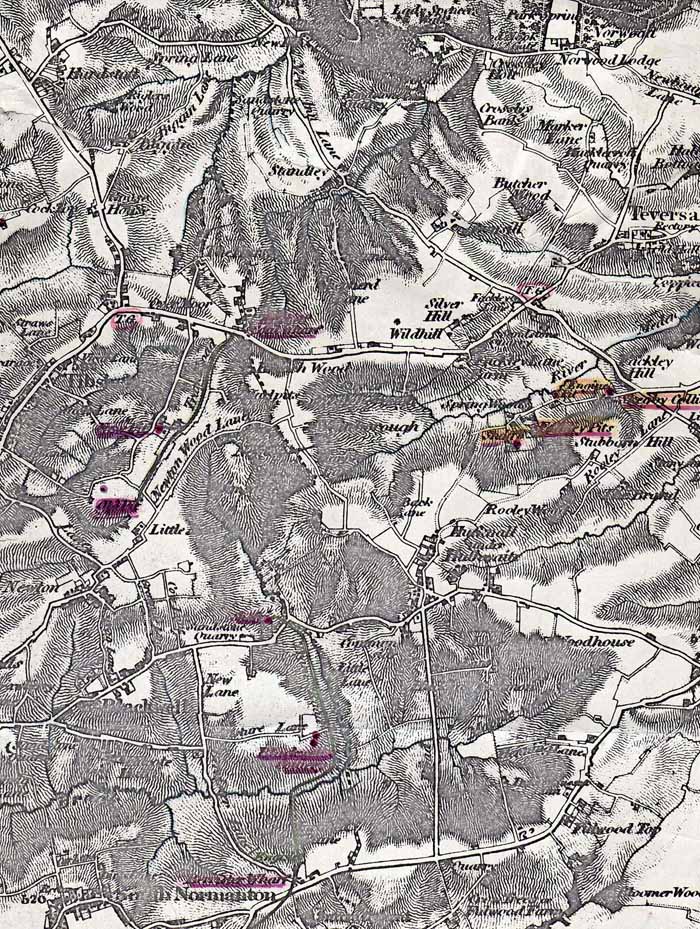
Sugar Hill pit (CV Hunter) (Butterley Park) not far from Ripley Old Engine pit. A section of all the seams shows: Ripley Soft 3’ 3”, Ripley Hard 6’ 0”, Car or Dunsil 2’ 0”, Oldgreaves or Waterloo 3’ 8”, Soft coal 1’ 6”, soft coal 2’ 3”, soft coal 2’ 3”, Minge 2’ 0”, Minge or Ell 1’ 0”, Deep Soft 4’ 0”, Deep Hard 4’ 1”, Piper 2’ 0”, Morley Park 4’ 0”, Dogtooth 2’ 2”, Clod coal and bat 9’ 0”, soft coal 2’ 0”, Kilburn 3’ 10”, a total of 21 yards and 1’ 2” of coal. (19.55m). No details of the workings are known.
Collieries Closed in 1870
- Alabama pit (Leicestershire)
- Boothman’s Engine pit 60 yards (55m) deep, Whaley Bridge
- Burn’d Edge No1 (Levi and Elijah Hall), New Mills, Yard mine 28” (0.70m), Aug
- Carnfield (Coke and Co)
- Granby Engine pit, last worked Mix 1870, 29 yards (26.5m) Brown Rake ironstone (11 yards (10m) above Black Rake which was 22 yards (20m) above Soft coal (Deep Soft) which was 18 yards (17m) above Hard coal (Deep Hard) which was 13 yards (12m) above the Piper seam). No2 pit (Phillips), No1 pit (Shaw’s) to west of Erewash Canal and old coal shaft to east of Canal 29 yards (27m) to Black Rake)
- Heanor Coombe
- Lount (Walker and Worswick) in Leicestershire had closed
- Newbold Field Chesterfield
- Newbold (Newbold Farm) (Newbold Iron and Coal Co) small area of thin coal (probably Piper) (however the plan was received and signed by Thomas Evans Inspector of Mines on 26th June 1886
- Newbould No1 Potters or Newbold (Deep Hard), (Newbold Iron and Coal Co) (Edley Taylor’s pit 1859), and met old works.
North West Derbyshire Pits
The map shows the 30 odd mines sunk in the area of Furness Vale, Newtown and Hayfield (North West Derbyshire).
 No1 Burn’d Edge 1 - No2 Burn’d Edge 2 or Pigot new pit
- No3 Burn’d Edge 3
- No4 Burn’d Edge 4
- No5 Little Mine pit
- No6 Burnt Edge or Berry Edge
- No7 Ardern
- No8 Ardern 2
- No9 Ollersett Hall or Brocklehurst
- No10 Pingot
- No11 Pingot Clough
- No12 Butterbank
- No13 Bullbower
- No14 Park
- No15 Lady pit
- No16 Barn or Dolly
- No17 Old Dolly
- No18 Marsh Lane
- No19 Bank End 1 and 2 or Ellibank
- No20 Red Moor Lane
- No21 High Lee (2 pits with same name)
- No22 Lower House
- No23 Lark Hill
- No24 Hague
- No25 Shaw Marsh
- No26 Mellor or Broadhurst Edge
- No27 Thornsett Hey or Cave Abdullum or Broom’s pit
- No28 Thornset Brows
- No29 Aspenshaw
- No30 Wethercotes
- No31 Noon Sun
- No32 Birch Vale.
These pits were all sunk after 1810.
Trespass
Oxclose Colliery (Sam Ward) there was a case of trespass by E Knight and Co in Blackshale seam, Grace and Archer prepared a plan 1870
Coal To London By Train
The Clay Cross Co sent 385,624 tons of coal to London by rail. The transport system had been revolutionalised with the coming of the railways.
Output
The Derbyshire coal output for 1870 was 5,102,267 tons, mined by 16,405 men and boys from 137 pits. The output from 27 Nottinghamshire pits was 2,115,372 tons and 599,450 tons from 11 Leicestershire pits. There were still 32 mines in Eire.
Butterley Co produced 986,595 tons with Hartshay producing a maximum of 41,715 tons and Langley 139,622 tons.
Referring To Colliery Accidents
Every one was a crime and ought to be punished as a crime and every mine should be thoroughly examined and if so one fifth or one tenth of head Managers and Undermanagers would be swept from the category of Managers and driven to ranks and not as workmen...they would be too lazy...quote, McDonald.
Guibal Ventilation Fans

Guibal Fan
In 1871 a Guibal ventilation fan 40 feet x 11 feet (12.19m x 3.35m) would be installed at Springwell, Staveley.
A similar Guibal fan but 30 feet dia x 10 feet wide (9.14 x 3.05m) had been installed at Hollingwood, Staveley in 1869.
Many more would be installed over the following years as there was a need for better ventilation due to the workings extending further away from the shafts and to try to keep the gas levels to workable limits. |


