1869
Sinkings in 1869
Bulwell pit opened, where sinking of a single shaft had begun in 1868 (John W Wright). At Bulwell the smallest pit in the Leen Valley they used one of Thomas North’s old engines upside down, on the surface, to run a steel wire rope down the shaft to work an underground haulage. This shaft was sunk to assist in the ventilation of the extensive workings of Cinder Hill and also to allow the men residing at Bulwell to reach their work more easily. It would allow a small amount of coal to be drawn, around 100 to 150 tons a day to supply the growing need at the Landsale at Bulwell village and the surrounding neighbourhood. The shaft was 307 yards (280m) deep and 10 feet (3.05m) dia. The small winding engine was a single vertical high pressure of 25 hp with 16” (0.42m) cylinder and a stroke of 2 feet 8 inches (0.82m). 2 plain egg-ended boilers 4 feet 6inches (1.4m) dia and 30 feet (9m) long supplied the steam. It was referred to also as No5 pit. The No4 pit together with the Bulwell shaft would supply air to the Bulwell drift and the topside workings and draw coal from both districts.
At No3 shaft pit bottom a single horizontal high-pressure haulage engine with 16” (0.42m) dia cylinder and stroke of 4 feet 6 inches (1.37m) giving 50hp. There were 3 egg-ended boilers at 4 feet 6 inches (1.37m) dia by 28 feet (8m) long. The engine draws the Bulwell drift at a gradient of 2 to 3 inches (0.05m to 0.07m) per yard (metre) for 900 yards (823m) with a single rope. It also draws 277 yards (253m) from topside incline to the Hempshill pit and then by endless rope along a 1,200 yards (1,097m) long level to No4 shaft, a total of 1,477 yards (1,350m).
 Water is pumped at night by spears from the Bulwell drift north to the foot of the Bulwell incline and then up the hill to Hempshill, from where the water runs to the No1 and No2 shaft bottom and is drawn there occasionally in the cages. There are no pumping engines. About 1,400 trams in these pits worked down to the Landsale wharves on ‘dandies’. Water is pumped at night by spears from the Bulwell drift north to the foot of the Bulwell incline and then up the hill to Hempshill, from where the water runs to the No1 and No2 shaft bottom and is drawn there occasionally in the cages. There are no pumping engines. About 1,400 trams in these pits worked down to the Landsale wharves on ‘dandies’.
At Cinder Hill surface there was an Underviewer’s office, Engineer’s office, Surveyor’s office, Time office (Round House) and brick makers and 3 weighing machines.
Thomas Holdsworth sank Pilsley No2 at 12 feet (3.66m) diameter to the Blackshale at 280 yards (256m), when the colliery was taken over by the Pilsley Colliery Co. A third shaft No3 would be sunk to the Tupton coal at 215 yards (197m).
Coton Park sunk in 1866 by Henry Green and
John Taylor founded the Coton and Linton Colliery Co in 1869 and leased 800 acres of mining rights.
DC winding shaft 600 feet (183m), UC and Pump shaft 660 feet (201m). Although there were 6 seams of workable section and quality the area was heavily faulted and affected by water from the overlying rock. The pit was flooded in 1888 forcing production to cease, however in 1889 production started again after pumping out the water and doing repairs. The pit was later referred to as ‘Strip-n-at-it’.
Liquidation
The colliery name was changed to Netherseal primarily due to several changes in the company in respect of its name and its finances and in Aug 1869 went into voluntary liquidation but with further capital raised was re-incorporated as West Moira Colliery Co Ltd on 28the Dec 1869. The name would be changed again on 25th Aug 1871 to the Netherseal Colliery Co Ltd.
Improved Atmospheric Engine
An improved atmospheric engine for winding and pumping was installed in 1866 at Moira colliery replacing the original one from 1821.
At Hardwick pit, (Derbyshire) (Barnes or Hardwick Coal Co), the Top Hard heads were stood. Surveyor William Deakin Wadsworth Feb 1869.
Collieries Changing Hands
Collieries changing hands: James Oakes and Co purchased Stoneyford Old from J Woolley, South Normanton changed hands from William Swann to Joseph Swann and New Tapton colliery (Messrs Booth and Co) was sold to Locoford Coal Co Ltd. CE Checkland became the owner of Mapperley and Stanley (Derbyshire), leased from William Drury Lowe of Locko Park. William Bland Church formed a new Co in association with Maples and Newhall Field (Shoddy) was re-opened again.
Explosion
There was an explosion at Swallow’s pit Mosborough Moor some time during the year and the Silkstone seam was abandoned. (Birley Colliery Co took over the pit some time later). Quarry Hill pit never produced coal, only stone, (quote- John Spencer, Engineer).
Two Sinkers Killed

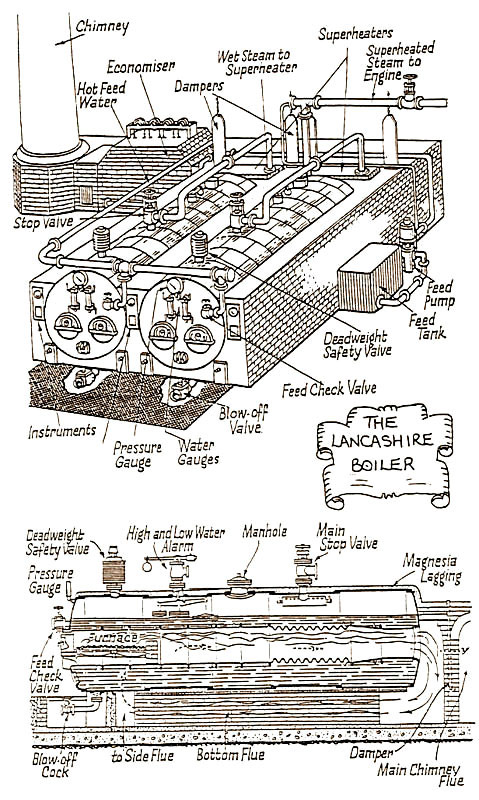
Construction of the boilers for the steam winders
Two sinkers John Marriott and Jabez Needham were killed on 9th March 1869 at Butcher Wood (Teversall No2) (Stanton Iron Co) when the sinking scaffold collapsed.
The Top Hard seam was reached at 217 yards (198m) on 2nd April 1869 and the sinking then carried on down to the Dunsil seam at 246 yards (225m).
The picture shows the construction of the boilers for the steam winders that were built piggy back style with the main coal winder at the rear with the Shonkey manriding engine to the front.
A Waddell fan 30 feet (9.14m) for ventilation was installed with a fan drift at No2 Shonkey shaft.
4 Men And A Donkey Were Drowned At Molyneux
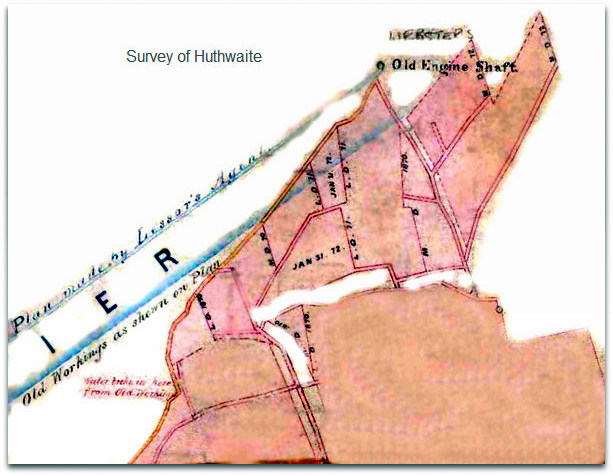
On the same day, i.e. 2nd April 1869 there was an inundation of water at Molyneux (or Molyneaux) colliery, Fackley, (Nottinghamshire), around midnight, in the early hours of the Saturday morning when 4 men (James Cooksey (34) married but no children, George Godson (30), William Wood (29), Sam White (19) and a donkey were drowned, (or from another account of the incident ? Joseph Cookson (married with 5 children), William Smith, George Dawson (30) had 2 children and Samuel White (19) plus 5 horses and 7 asses were drowned when the water flooded the Dunsil workings, the bodies being recovered some 3 weeks later on 20th April). Millership the Agent descended the shaft with a view to bringing up as many of the miners as possible. He was successful in bringing up William Godson (30) of Stoneyford Lane, Timothy Dennis and John Prior of Sutton. The newspaper accounts differ widely and this example shows how reporters can get the account wrong!
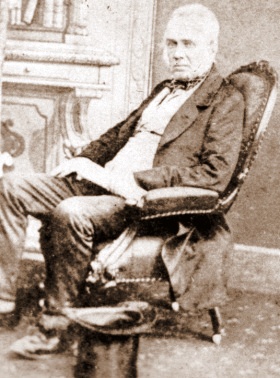
 The mine was leased to Eastwood and Swingler, from the Dowager Lady Carnarvon in 1855. The workings had encroached upon a water gate or sough which had been driven in the area between 1666 and 1784 which was thought to be some distance away as shown on a plan of the works made by John Boot (1801-93), Surveyor of Huthwaite (pictured). It was found that the gate had been drawn in the wrong place on the plan and Boot was severely criticised for the inaccuracy. However the firm of Surveyors and Mining Engineers begun by Eleazor Boot (1780-1861) survived, with John Thomas Boot of the Orchards, Huthwaite, the grandson (1835-1914), continuing as Agent for the mines and advising later on sinkings at New Hucknall and Clifton. Many plans of other collieries were made by John (Iohn) the father, and John Thomas Boot, the son (mainly to show amounts of coal worked). The mine was leased to Eastwood and Swingler, from the Dowager Lady Carnarvon in 1855. The workings had encroached upon a water gate or sough which had been driven in the area between 1666 and 1784 which was thought to be some distance away as shown on a plan of the works made by John Boot (1801-93), Surveyor of Huthwaite (pictured). It was found that the gate had been drawn in the wrong place on the plan and Boot was severely criticised for the inaccuracy. However the firm of Surveyors and Mining Engineers begun by Eleazor Boot (1780-1861) survived, with John Thomas Boot of the Orchards, Huthwaite, the grandson (1835-1914), continuing as Agent for the mines and advising later on sinkings at New Hucknall and Clifton. Many plans of other collieries were made by John (Iohn) the father, and John Thomas Boot, the son (mainly to show amounts of coal worked).
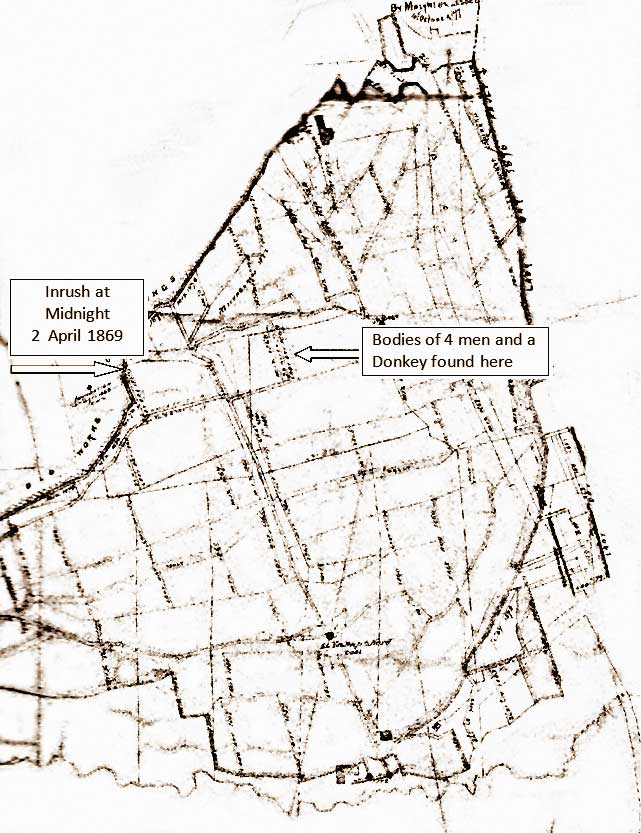
Following the inrush, three men ran to the pit bottom as the water rushed in behind them and they clung to the winding rope as the water rose up the shaft. As was usual in those days no engine man was on duty at the surface on the night shift, and the men were saved only by their cries for help being heard by Henry Spittlehurst a night shift pump man at another shaft nearby in Mansfield Close, who raised the alarm. One of the rescued men named William Godson, was always referred to afterwards as ‘Squealer Godson’ (subsequently working at New Skegby, later renamed Brierley Hill, then Sutton colliery). The other two men were James Dennis and George Godson. The plan above from Teversal Survey office shows the point where the inrush occurred. There were only two small benks working with 7 men. Therefore I disagree that there were 5 horses and 7 asses underground.
However I do agree that the Dunsil workings below Top Hard would have been flooded also at that time.
 At Molyneaux, Hard coal gotten was 11 acres 2 roods 39 perches (4.75 ha) and Dunsell, 9 acres 0 roods 30 perches (3.75 ha approx). At Molyneaux, Hard coal gotten was 11 acres 2 roods 39 perches (4.75 ha) and Dunsell, 9 acres 0 roods 30 perches (3.75 ha approx).
No exact date can be found for the sinking, but it was possibly around 1815–1823 (another estimate but very doubtful being 1795). It is thought that the shafts had been sunk but the pit was left unworked for a considerable time before being re-opened in 1856 due to the Pinxton to Mansfield Railway being operational in 1820. About 30 men and boys were employed in the 2 seams and the firm of Ironmasters from Derby also employed an unlettered Underviewer, 42 year-old John (or Joseph) Millership to be in charge of the mine, assisted by an incompetent Deputy, George Churchill.
The plan shows Molyneux Dunsil seam workings (from 1856-1880).
The mine was badly ventilated and in an unsafe condition, and the miners were regularly soaked. The lessees relied on the surveys of John Boot, (Photo Opposite) Lady Carnarvon’s Agent and Surveyor of Hucknall Huthwaite. However he was only concerned with amount of coal extracted for Royalty payment purposes and neither he or his son John Thomas Boot had seldom been underground in the seven years 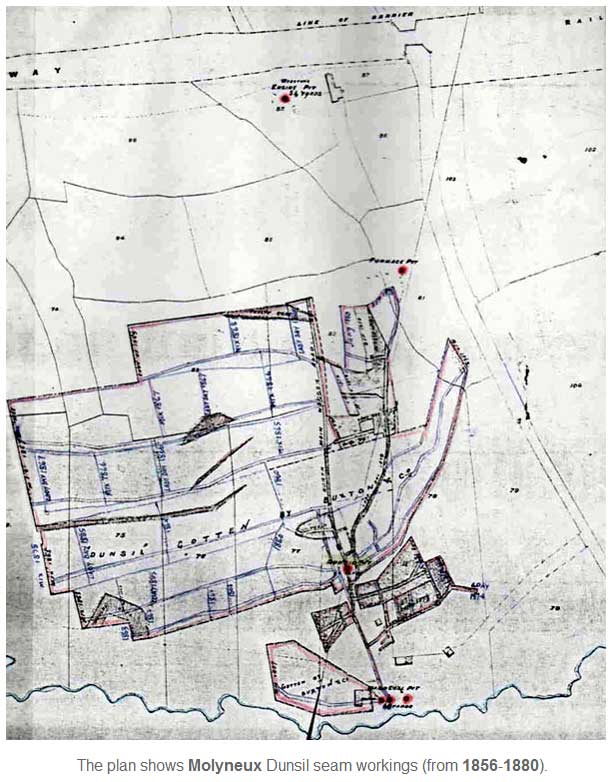 leading up to the tragedy, and probably not within the 5 years preceding the inrush. He left the surveying to his son-in-law WG Treadwell, as the only way of entering the mine was by sitting on a crossbar at the end of the hemp winding rope. leading up to the tragedy, and probably not within the 5 years preceding the inrush. He left the surveying to his son-in-law WG Treadwell, as the only way of entering the mine was by sitting on a crossbar at the end of the hemp winding rope.
Supposedly Treadwell had attempted to survey the workings a few days before, but was unable to complete the survey due to the foulness of the air and had abandoned the project at that time.
The plan below shows workings continued after the disaster. One arrow shows the position of the inundation and the other the position of the bodies found after the mine had been pumped dry.
John Boot (1801-93) had stated that he did not survey the pit himself and had made the plan from an old plan in the office of Mr Twigg, Agent to Lord Porchester, - (extract from the Colliery Guardian 28th May 1869).
The water had risen up the shaft to within 40 yards (36.5m) of the top by 3 am on the Saturday morning. A portable engine was loaned by the Stanton Iron Co from their colliery nearby and used to wind water out of another shaft, but by 5 pm the water level had only been lowered 1 inch (0.025m). The mine was completely flooded and it was some weeks before pumping operations dewatered the mine in order to recover the bodies, and a new shaft had to be sunk. It was a long time before coal getting was able to recommence. Part of the Top Hard working is shown on the plan.
At the time of the inundation, (another account, written by Margaret (Millership) Noakes (member of Ashfield Heritage Society, died 2007 aged 73), the great granddaughter of Joseph Millership states that it was the evening of 20th April 1869 at about 8.30pm when the men had just started work, that the men concerned struck the old water level, supposedly a barrier of 24 yards (22m) was left). The plan showed that the working benk was supposed to be some 70 yards (64m) away from the old water gate, when in fact it was right up to it.) (Twigg’s plans are also referred to in the Ripley district). Trespass into other owners’ leases was another important point to watch!
Millership had come to work at the Molyneux mine around 1865 after having previously been a mine Manager in West Bromwich, Staffordshire, where his father had been a Mine Agent.
He resided near the Tavern on Forest Road, Skegby with his wife and 5 children aged 17 to 6.
An inquest was held at the Carnarvon Arms by Mr DW Heath, Solicitor and Coroner. He found that the mine was extremely under-capitalised before being leased to the Buxton’s. Supposedly the Top Hard seam had been exhausted in 1806. This statement is rather ambiguous – rather it meant that the extent of the working had reached its lease’s area, economic / practical limit due to ventilation/water/haulage problems. This refers to a different area of coal worked adjacent as the area worked as shown on the plan is relatively small, and also as shown by the amount worked in acres. The Dunsell (Dunsil) working had then carried on in that area until about 1820/1823 when difficulty in selling the product caused its closure. The Pinxton to Mansfield Railway had opened shortly before this and the mines in the Upper Meden Valley, including Molyneux could not compete with the selling cost per ton and so closed down. Maybe this is why Molyneux was not developed at that time. Prior to this a steam pump had been used to keep the water level down.
However going back to the inundation or inrush of water, this was in the Top Hard seam, so the working of the coal which encroached on the old level must have been in that seam, i.e. the Top Hard, not the Dunsil seam as implied however these workings would be flooded also as they were some thirty yards (27M) deeper. One of the workmen stated at the inquest that they had not bored for water since July the previous year 1868 but also stated at the inquest that he had warned those in charge of the risks and had threatened to report the conditions that they were working under to the Mines Inspector.
Freak Accident
It was reported that some time earlier there was a freak accident at the Forecourt pit at Tibshelf (Derbyshire). A man called Brooks, who lived in a thatched cottage on Back Lane was walking round the pit top when he accidentally fell down the shaft. By a strange coincidence he fell onto the back of an ass that was pulling some tubs into the pit bottom. The man survived the 30 yards (27m) fall, but the ass was killed.
West Hallam
Potter’s Soft Coal pit at West Hallam was working in 1869 but the other Potter’s pit to the west had finished earlier. Butterley Co worked West Hallam pit at this time.
Miners' Housing
80 houses were built at Danesmoor by Clay Cross Co to house their miners for the new sinking. #B-Wadsworth
Other Collieries Sunk or Opened in 1869
- Blackwell (Bainbridge and Co Ltd)
- Boythorpe (Mrs Hall) Blackshale, plan by William Deakin Wadsworth
- Broxtowe and Bulwell (T North)
- Bull Close (Hewitt), Blackshale, faults and met old works, Grace and Archer Land and Mineral Surveyors
- Butcher Wood (Stanton Iron Co)
- Cadley Hill (Hall and Boardman) (South Derbyshire)
- Compstall (Messrs Andrews and Son)
- Devonshire (Devonshire Silkstone Co)
- Devonshire (George Senior)
- Killamarsh (Sheepbridge Iron Co)
- Mapperley (Checkland and Co)
- Netherseal (Binns, Jackson and Co)
- Old Swadlincote (Church and Maples) (South Derbyshire)
- Owl Cotes (Messrs Galloway)
- Ryefield Soft Coal (Denby Iron Co) Piper shaft position 43/3946/320862
- Silkstone (Armitage Bros)
- Speedwell sinking (Staveley Coal and Iron Co)
- Waingroves (Butterley Co), opened.
(19 Pits)
New Owners
E Nicholls sold Brampton New colliery to Jackson and Co, and Joshua Townley sold Holmewoode Heath to Wingerworth Co
Stanton colliery owned by Joseph and Nathaniel Nadin.
Collieries Closed in 1869
- Apperknowle (G Wright)
- Buckland Hollow or Ambergate (Buckland Hollow Coal Co), Kilbourne, old hollows met
- Bull Close (JL Hewitt) Blackshale, met old works, Grace and Archer Surveyors 1869 and see 1890
- Califat (Coleorton) (Leicestershire), Upper Main
- Dronfield (Messrs Lucas and Sons)
- Dunstone (George Senior)
- Gosforth (Drongfield Silkstone Coal Co) Blackshale
- Green Lane (W Booker and Co)
- Highfield (Oakerthorpe Iron Co) Blackshale
- Hucknall (Mellers), Huthwaite, Top Hard, left off because of water
- Killamarsh (Webster and Co)
- Mosbro’ Moor (Lunk Worrall)
- Newbold (Messrs Nadin and Pearson) start 1858/59/60, Potters seam
- New Langley (Butterley Co)
- New Tapton (Locoford Coal Co Ltd)
- Old Cotes (Messrs Galloway)
- Old Sleights (Coke and Co)
- Renishaw (Appleby and Co)
- Ryefield (Denby Iron and Coal Co Ltd) Piper 64 yards (58m), Midsummer, abandoned Nov 1869
- Skegby (John Dodsley) finished after 22 years
- Staveley (J Marples)
- Walton (George Hewitt or JR Hewitt) Wingerworth, Threequarter seam 4’ 6” (1.37m), Shafts 27 yards (24.5m) and 31 yards (28m), Mr Wyatt Manager, John Thomas Woodhouse Surveyor
- Water Gates (Butterley Co)
- Whaley Bridge (John Wesley Harvey), John Wesley Harvey, Yard mine, winding level to Yard or Kiln seam was 127 yards (116m) worked to outcrop 5 Feb 1869. There was a slant brow and at the old pit it was 70 yards (64m) to the tunnel. 3 shafts in line - Winding, Pumping and Balance and an UC shaft 65 yards (59.4m) to 18” seam to the N. There was a water level to the River Goyte 15 yards (13.7m) deep at the pit mouth (shaft). It was 14 yards (12.8m) down to the 9” seam, 67 yards (61.2m) to Callen 7” mine. There was a wharf at the Forest Canal at the side of the River Goyte
- Woodhouse Lane (JH Gosling).
Fatal Accidents in 1869
- Alma, William Holdsworth (21) and William Walker (26) killed when a surface boiler exploded 14 Jan 1869
- Axedge, John Ashmore (56), run over by tubs 13 Feb 1869
- Black Rake, George Hufton (13) 30 Jul 1869
- Boythorpe, George Hopkinson (36), killed in shaft when pump fell 29 Jun 1869
- Brands, Samuel Jepson (32), fall of roof 6 Dec 1869
- Bretby ? William Parker c26 Dec 1869
- Brinsley, Charles Godfrey (20) was killed 15 Feb 1869
- Britain, John Stanley (50), explosion of firedamp 15 Dec 1869
- Bulwell, William Walters (21) 15 Mar 1869
- Butcherwood 2 fatals in shaft 9 Mar 1869 (see above)
- Church Gresley Stephen Evans c20 Dec 1869
- Clay Cross, Edward Rowland (12), crushed by the cage 2 Oct 1869
- Clay Cross, John Smith (19), fall of roof 30 Oct 1869
- Cotes Park, John Cook (33), fall of roof 25 Feb 1869
- Cotes Park, Wright Walker (21), fall of roof 12 Oct 1869
- Coleorton, William Cooper (23), run over by tubs 6 Apr 1869
- Coleorton, Herbert King (18), fall in roadway 13 Sep 1869

- Denby, Thomas Kerry (14), fell down shaft 4 Dec 1869
- Devonshire, James McCaul (?) and Thomas Hodgkinson (?) were killed by an explosion of firedamp 7 Jan 1869
- Granville, ? Thomas Thacker c1 Jun 1869
- Grassmoor, William Hallam (22), fall of roof 14 Jun 1869
- Greasley, Herbert Wright (19) 20 Jun 1869
- Hartshay, James Jackson (42), crushed by tubs 16 Mar 1869
- Hartshay, Thomas Simms (23), fall of roof 18 Jul 1869
- Hollingwood, John Wright (?) 6 Aug 1869
- Hollingwood, Johnathan Haylord (26) and Henry Hibbert (27) 20 Dec 1869
- Hollingwood (Richard Barrow), John Haywood (26) and Henry Hibbert (27) were killed in an explosion on 19 Dec 1869.
- Leabrooks, Samuel Jepson (32), 19 Dec 1869
- Moira, John Denis (60), fall of coal 14 Apr 1869
- Moira, Joseph Sharpe (38), explosion of powder 23 Oct 1869
- Morton, John Neale (24), fall of roof 18 Mar 1869
- Nesfield, Daniel Cockling (26), fall of roof 13 Feb 1869
- New Hollingwood, Patrick Morgan (22), run over by tubs 13 Nov 1869
- New Langley, John Stevenson (13), run over by tubs 15 Feb 1869
- Oakthorpe, Francis Dennis (55), run over by tubs 26 Jul 1869
- Palmerston (Pinxton), James O’Brian (38), fall of roof 23 Dec 1869
- Pilsley, John Cutts (16), crushed by a pony 10 Mar 1869
- Plumbley, William Pendleton (17), run over by tubs 9 Feb 1869
- Renishaw Park, Amos Platts (28), explosion of firedamp 27 Jan 1869
- Renishaw Park, Patrick Verdon (?), fall of roof 7 May 1869
- Renishaw Park, William Bradbury (61), fall of roof 2 Jun 1869
- Seymour, Robert Sweatmore (..?) 22 Jan 1869
- Shipley, Joseph Durron (35) - Sep 1869
- Shipley Newcastle, Joseph Smith (?), fall of coal 11 May 1869
- Shipley, Joseph Druro (42), fall of roof 30 Sep 1869
- Shipley, John Anthony (13), fall of roof 24 Dec 1869
- Sleights, Pinxton, 15 Jul 1852, John Gibson (?) killed by an explosion of firedamp
- Snibston, Joseph Bettison (18), caught in machinery 7 Dec 1869
- Swadlincote, George Bloore in Eureka seam c12 Feb 1869
- Swannington, Thomas Bird (28), fall of roof 5 Aug 1869
- Swannington, William Siddons (16), kicked by a pony 10 Sep 1869
- Swannington, Fred Johnson (14), caught in machinery on surface 25 Nov 1869
- Tanyard, Enoch Beresford (31), run over by tubs 8 Nov 1869
- Tibshelf, a pit owned by Charles Seely and Co - a sinker William Massey (36) was killed when a stone fell down the shaft on 10 Sep 1869, sinking had begun in 1867, down to the Blackshale seam
- Whittington, George Illsley (59), fall of coal 19 Nov 1869
- Willey Lane, Herbert Wright (21) 9 May 1869
- Willey Lane, Herbert Wilson (16) 20 May 1869
- Wingerworth, Samuel Simpson (15), caught in machinery on surface 10 Apr 1869
Outputs
In 1869 the output from 140 Derbyshire pits was 5,460,090 tons and 1,575,450 tons from 26 Nottinghamshire pits and Leicestershire output from 10 pits app 650, 700 tons. Incidentally there were still 33 collieries in Eire. Many Irishmen would flock to the English mines in particular in later years.
Butterley Co produced 918,621 tons for the year with Brands colliery producing a maximum of 201,551 tons.
Oil
Oil was again seeping into the pits at Riddings, some 20 years after being first discovered and it was reported that up to 300 gallons a week was collected and used for lubrication and fuel oil for miners’ lamps.
Ups And Downs Of The Industry
It is noticeable how the ups and downs of the industry seem to have been every other year and there was an upward trend again as 1871-1873 would be good years. There was a period of stability in the industry of about 8 years before a further downward trend once more.
It was a bad year for coal generally throughout the country. |


