1867 - Page 2
Thomas North Bankrupt

In 1867 Thomas North of Cinderhill owed £190,574 to Wright the banker after his partner
Thomas Wakefield was declared bankrupt. North was generally liked by his workforce because he had found work for many in a place of poverty and poorly paid frame knitting. He had found them decent housing with gardens or allotments and pig styes at a reasonable rent. Over the years there were a few strikes and lockouts over wage rates but the strike leaders were tolerated and not sacked.
Associated work was provided by clay diggings, brick works, a timber yard, gas works, a farm, landsale, canal wharves and railways.
Plan of Tibshelf
Woodhouse and Jeffcock had made a plan of lands around Tibshelf and mentioned Mr Chamber’s pit at Newton, thought to be Littlemoor colliery. According to JA Twigg later, Chambers had filled in several old shafts. Résumé by John Boot and Son 15 Feb 1867.
Surveyor Fined By Inspectorate
There was a report in the Burton Chronicle of a Surveyor at Wolverhampton being fined by the Inspector for a breach of Regulations.
Coal Commission Plans
Plans of all seams and workings were produced for the Coal Commission in 1867 to ascertain the amount of coal worked to date. John Boot calculated that at Skegby 105 acres of Top Hard had been worked. Similar plans and calculations were produced for other areas.
John Boot's Plan
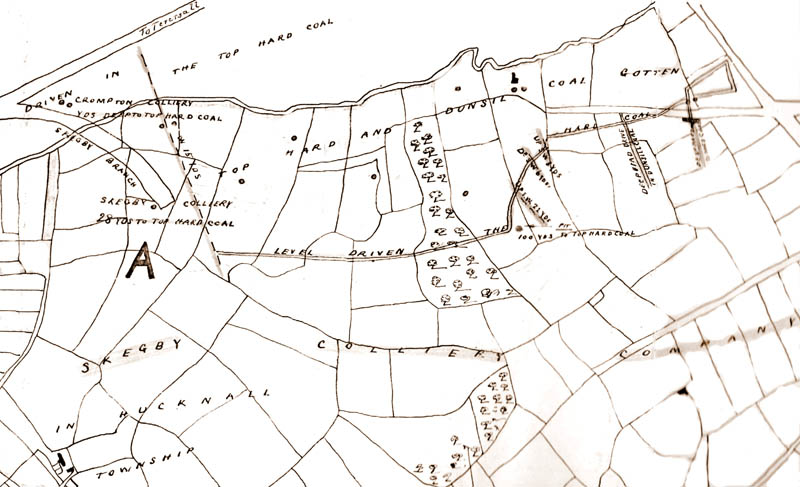
During 1867 John Boot produced a plan showing an area of Hucknall Common coal or High Hazles, 100 yards (90m) above Top Hard worked from an adit on Cross Lane at Huthwaite Common (never located).

In June John Boot and Son produced a further plan showing areas of coal extraction in the Blackwell area – Berristow 32 yards (29m) deep 18½ acres (7.5 ha) and 78 acres (31.5 ha) to the west. At Hill Top, 69 yards (63m) (same area) 5 acres (2 ha) of coal had been worked, and to the west 8½ acres (3.43 ha) and 48 acres (19.4 ha) towards the outcrop. Carter Lane 48 acres worked to outcrop. South Normanton, Dunsil seam 11 yards (10m) deep worked to outcrop, 1795-1830, pillar left round village. Normanton Common 101 acres of Waterloo, 34 yards (31m) deep worked at Carter Lane. Carnfield 135 yards to Deep Hard. In the Tibshelf district 730 acres of Top Hard worked from the outcrop to Newton Wood Lane, 65 yards (59.5m) deep to Straw Lane. A pillar was left under Tibshelf village. There was a gang line from several pits leading to a coal wharf at Tibshelf Ramper and a Toll Bar at the Junction with Chesterfield Road on the turnpike road. A further plan, the one above, was drawn in July 1867 by John Boot showing some of the shafts in the upper Meden Valley and referring to the Level driven in the Hard coal. It shows a branch line into Skegby colliery from the Tibshelf railway line. A Toll bar was situated at the Carnarvon Arms PH junction.
Unrest
During the summer months there was unrest for the Derbyshire and Nottinghamshire Miners’ Association, at the end of the great lockout in North Derbyshire. At Staveley there were 3,000 men locked out and the Staveley Iron and Coal Co brought in ‘blacklegs’ to break the strike. These men were hounded. There had been a similar dispute in South Derbyshire in February 1867.
Bretby
At Bretby colliery the Manager was William Johnson. The best collier could earn 6s (30p) whilst the worst about 4s 6d (25p) for an 8 hour shift in a stall. At the pit a Doggie was a man responsible for a section of the mine, the haulage of coal from the face by ponies driven by lads. He also made sure that the rail tracks were in good order. When the mine was sunk in 1855 the rank of Deputy did not exist and experienced men were chosen by the Manager to carry out duties on his behalf. A further lock out of 2,000 men and boys was at Newhall during May 1867.
Collieries That Changed Hands in 1867
- Awsworth and Bennerley were sold by G Parker to Hicks, Whittaker and Co
- Bennerley changed hands again from Hicks, Whittaker and Co to FC Gillett
- Birchwood and Summercoates was leased by CRP Morewood to Messrs Seely in August 1867
- Brampton New colliery from E Nicholls to Jackson and Co
- Denby Iron Works from W Hope Dawes to G and W Hope Dawes
- Smedley and Church sold Gresley Wood to the Gresley Wood Co Ltd
- Walker and Co sold Ingmanwell to JW Day and Co
- John Ray owner of Kilburn Colliery died in 1867 and the ownership passed to his son, the Rev’d George Henry Ray
- Monk Wood was sold by JC Plevins to the Monk Wood Co Ltd
- Skegby, Skegby Colliery Co became Skegby Colliery Lime and Brick Co
- South Normanton from William Swann to Joseph Swann
- Stoneyford Old was sold by M Royston to J Wooley
- Swanwick changed hands from WP Morewood to CRP Morewood
- J Jowittsold Thornsett to T and J Bennett
- Tibshelf from R Storrer to J Moseley
- Tibshelf Old and Tibshelf New changed hands from John Chambers to Edward Chambers
- Whaley Bridge pit was sold by Thos Gisbourne to R Broome and Co.
Collieries Sunk or Opened in 1867
- Annesley (Wm Worswick) sunk to Top Hard
- Awsworth (FC Gillott), 2 shafts 13 ft (3.96m) dia sunk to Top Hard, No1 shaft, High Main 4ft 0½in (1.23m) at 228 yards (208m), Low Bright 2ft 7in (0.79m) at 374 yards (342m), High Hazles 2ft 2½ in (0.67m) at 406 yards (371m), Combes 2ft 1in (0.63m) at 473yards (432m), Top Hard 4ft (1.22m)
- Bretby No2 sinking
- Clay Cross (Shepherd and Smith)
- Denby New (Drury Lowe) July
- Hasland (George Senior)
- Clifton sinking (Nottingham and Clifton Colliery Co)
- Moor Green (Barber Walker and Co) sinking
- Park House Nos 6/7 (Clay Cross Co) sinking
- Renishaw (Charles S Appleby) sinking
- Rose Iron Pit (George Andrews)
- Streetfield (Ruth Worrall)
- Tibshelf Blackshale (Chas Seely and Co) began sinking
- Unstone (Bainbridge and Co)
- Wingerworth Coal Co was sinking Holmewood. 4,000 acres of mineral rights were available.
Teversall

Whitehouse & Co who had a colliery at West Hallam commenced the sinking of 2 shafts at 10 feet 6 in (3.2m) or 10 feet (3.05m) diameter at Teversall No2 on 12th March 1867 by the side of a copse named Butcher Wood near Teversall village to the north east of Silver Hill mine. However the firm ran out of funds and Crompton, Newton & Co took over and George Crompton, a Director of Stanton Iron Co sold out to that company, who took possession on 5th October 1868. The downcast shaft was widened out to 14 feet (4.27m) diameter and sinking recommenced. However the upcast shaft was continued at 10’ 6” (3.2m) dia. The mine was renamed Butcher Wood colliery a name that would be synonymous for ever albeit that the name would be changed to Teversal(l) only a few years later from 2 February 1871. The plan shows the extent of the workings on that date and was surveyed by Richard G Coke of Chesterfield. From commencement in 1868 to 24 June 1870 5 acres 0 roods and 6 poles had been worked and from June 1870 to 2 February 1871, 11 acres 0 roods and 15 poles of coal had been extracted. It was renamed Teversall by the Stanton Iron Co. This sinking was on the edge of the concealed Coalfield as the Permian measures were brought to the surface and completed the edge of the Coalfield that began at Wollaton through Bilborough, Nuthall, Kimberley, Selston and Pinxton. No tubbing was required in the shafts although they were always wet and running with water creating a slimy mess on the shaft sides, particularly the Upcast Shonkey shaft. Similarly the Stanton Iron Co began sinking 2 shafts at 10 feet (3.05m) dia towards the Lane leading from Fackley to Hardwick Park and the New Inn (Hardwick Inn). The Downcast shaft at 87 yards (79.6m) to Top Hard seam and was called Silver Hill (named after the farm nearby), later known as Coopers' shaft probably named after the big butty who ran the mine. The UC shaft was 148 yards (135m) south and was known as the Dunsil pit. It was sunk down to this seam at 90 yards (82.2m). An old plan of the Top Hard seam for that colliery shows that the shafts were connected at Top Hard level. (see Mix (Michaelmas) Day 1873.
Collieries Closed in 1867
- Beauchieffe (H Hunt)
- Bonsall (J Srigley)
- Brickyard (J Marples) Staveley, Deep Soft, sunk 1865
- Bridge House (…?), Chesterfield, Deep Soft or Dunston
- Britannia (Johnson and Co)
- Brockwell Wood (WH Bridden or Henry Naylor?) Blackshale
- Brundedge (Levi and Elijah Hall)
- Bull Close (Ann Wright) abandoned
- Buxton (R Broome and Co)
- Calow (Sayers and Co)
- Clay Cross (G Clegg)
- Colliery (C Rotheram)
- Dore (J Smith)
- Dunston (Messrs Lancaster) Cobnar Wood, Deep Soft
- Eastwood (Mrs Manson and Others) to Lady Day 1867 – original plan made by Richard G Coke, Ankerbold May 1854
- Engine pit at West Hallam sunk by J Sutton in 1794-1795 was abandoned
- Furness and Bagsworth (J Stott and Co)
- Gas House Chesterfield, Deep Soft
- Green Lane, Dronfield (W Booker and Co)
- Hallows (W Booker) Blackshale
- Hallows (R Wright) Dronfield
- Highfield (R Wright)
- Dirty Hucknall (Hucknall Colliery Co) after 106 years
- Ingmanwell (JW Day and Co)
- Lount (Walker and Worswick) (Leicestershire)
- Ludworth (J Jowitt)
- Monkwood (Monk Wood Co Ltd)
- Mosbro’ Moor (R and J Swallow)
- Ridgway (FH Hutton)
- Skellingthorpe pit (Chas Seely) Soft coal, July; finished at Michaelmas
- Watnall (Barber Walker and Co?).
(34 Pit)
Willey Lane (Barber, Walker and Co) sunk 1840 to Top Hard at 183 yards (167m), closed at Michaelmas, 29th Sept 1867. The pit was connected to nearby Underwood another Barber Walker Colliery.
West Hallam (West Hallam Iron and Coal Co): Threequarter, Low Main, Blackshale and Ironstone. An old tramway led from the pit at 2’ 10” (0.86m) gauge.
Accidents in 1867 - Sinkers Killed
At the new colliery Alfreton a number of bricklayers were bricking the top of the shaft on a scaffold suspended from the top of the shaft by a rope 3 inches (0.08m) thick. About 6 o'clock a fresh shift of men went down the shaft but the additional weight proved too heavy for the scaffold which gave way falling to the bottom of the shaft about 10 feet (3m). There were 24 men on the scaffold and 10 sustained injury with one breaking his ankle. The men were taken home in traps.
Whilst sinking a shaft by the copse called Butcher Wood, Teversal pit (owned by Whitehouse & Co) the rope broke whilst the sinking bucket that hauled dirt up the shaft was being lowered into the shaft and it fell down onto 5 sinkers at the bottom, 4 of whom escaped whilst the fifth sinker John Aldred (35) was struck in the back by the hoppit and the heavy metal rope coiled around his body. However he was only badly bruised, a very fortunate man. Two sinkers would be killed later though as the shaft neared the Top Hard seam level.
Newhall Flooded
Newhall mine belonging to Nadin’s began to flood on 1 Oct 1867.
Collier Bankrupt
Saturday 7 Dec 1867 Daily News, Henry Richards, collier at Awsworth was declared bankrupt 19 Dec 1867.
Output
The output for 1867 was 4,550,550 tons from 150 Derbyshire pits and 1,575,000 tons app from
24 Nottinghamshire pits. The output from the 10 Leicestershire pits was around 750,000 tons.
Price Of Coal
Average price in London was 20s 8d (£1.03) a ton. However it was not a good year for the Derbyshire and Nottinghamshire Association.
Lockouts
Lockouts at several companies in North Derbyshire during the year had created unrest and hardship and again blackleg labour was brought in the crush the union. The lockout in South Derbyshire was similar with the added grievances of the men stating that they should not be paid wages in public houses or money be given to butties to pay for goods from Tommy shops. At Bretby (owner Mr Johnson) stated that he would stop the practice.
Miners' Housing
George Stephenson built 80 houses for his work force at Danesmoor.
The year was good for coal production throughout the country. |


