1836
Collieries Sunk or Opened in 1836
- Blackwell Pastures pit (Diminsdale Colliery Co) sunk 40 yards (36m) to Top Hard
- Tom Lane pit, (Barrow) Inkersall Road near Duckmanton began production
- Holmewood (Hardwick Coal Co)
- Loscoe (Goodwin and Co) – claiming ancient ‘Zouch’ coal
- Coke and Co sank Pinxton No2 pit (later known as Plymouth) to 130 yards (119m) deep in 1836, close to Longwood Hall. (The neighbouring No1 pit Sleights being sunk in 1780 was also known as Palmerston’s) (Coke)
- Underwood pit (Oakes) began production
- Willey Lane or Willey colliery (Barber Walker) near Underwood sinking 190 yards (173.7m) to Hard Coal.
Fire Baskets and Furnaces
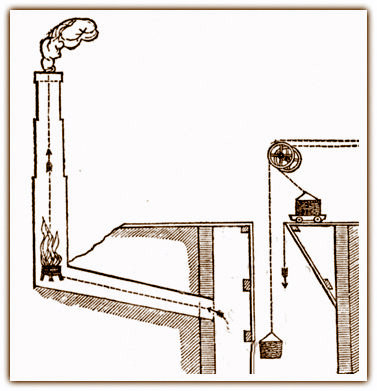 Until now there were no pits in Derbyshire using underground furnace ventilation as the only ventilation necessary was obtained using fire lamps or fire baskets which were hung near the top of the upcast shaft or in a small staple shaft alongside and a connection made to it. The hot air created by fire lamps could pull around 10,000 cu ft/min of ventilation around the workings and finally up the shaft. Until now there were no pits in Derbyshire using underground furnace ventilation as the only ventilation necessary was obtained using fire lamps or fire baskets which were hung near the top of the upcast shaft or in a small staple shaft alongside and a connection made to it. The hot air created by fire lamps could pull around 10,000 cu ft/min of ventilation around the workings and finally up the shaft.
The sketch shows a fire basket hanging in a small shallow shaft adjacent to the main return airway shaft.
At the small pits with 2 shafts, reliance on natural ventilation between the two shafts was practised. However as stated before, there was a reversal of the air direction in summer and winter and during the change period the air could have been stagnant.
Firstly underground furnaces were constructed then surface furnaces would be adopted later, usually with a fairly large dia chimney or cupola.
At some of the ‘larger’ mines the method of working was staggered longwall and the ventilation current was sent along the face so that the gobbing area was only ventilated by leakage. If too much air was passing along the face the miners complained that they had to shroud their candles otherwise they were extinguished.
At Speedwell the quantity of air generated by the furnace was 40,000 cfm (cubic feet per minute). Mr Biram’s anemometer was just coming into use. This instrument would eventually be used at every colliery in the country in the 20th Century to measure the air speed etc.
Collieries at Work in 1836
- Beggarlee
- Belper Lawn
- Brinsley
- Coppice x 2
- Godkin
- High Lane Lewcote x 3
- Hill Top
- Ilkeston North, West and South West
- Kilburn
- Loscoe
- Mapperley
- Marehay
- Marehay Hall
- Openwood Gate
- Ripley Woodside
- Salterwood
- Smalley
- Stoneyford.
Collieries Closed in 1836
- Ashgate (His Grace the Duke of Devonshire)
- JG Barnes Esq worked the Brampton Moor coal at his pit 1831 - 1836
- Blackwell Pasture (Diminsdale Colliery Co) 1836
- Swadlincote Darklands Deep Foundation, (Nadin’s) (South Derbyshire), Little and Main seams
- Upper Birchwood (John Poundall and others), Pinxton.
There was a Coal Mines Registration Act of 1836
Sheffield Independent – Saturday 28th May 1836
Fossil remains of a crocodile were found in a coal pit at Whittington, Chesterfield. Unfortunately part of another one was destroyed by using explosives.
Fatal Accidents 1836
- Awsworth (Thomas North), Thomas Hope, collier, went into a part of the mine that had not been cleared of foul air (methane gas) and ignited it with a candle flame. An explosion ensued on 23th Feb 1835 and he was terribly burnt about his lower body and head and he died from his injuries on 8th Mar 1835.
- Brittain. At the pit belonging Mr Brittain 4 men were burnt to death by an explosion of firedamp on Monday 30th May 1836. Isaac Tupman and Cook descended the shaft at 4 am to go to their place of work. Cook remarked that it was not a fit place owing to it not being worked for a week but Tupman decided opposite and ventured with his candle into the working. Cook followed a few minutes later but left his candle behind and on overtaking Tupman observed that there was a little wind, when turning round saw the peculiar blaze indicative of the presence of foul air and in order to avoid the impending danger threw himself into a 'thurl waste' whilst Tupman hurried towards the shaft. There was an explosion and the air continued to blaze for about 10 minutes. About half an hour later Cook ventured to leave his place of security and went to the shaft bottom where he found Tupman crawling on his hands and knees and dreadfully burnt, but what added to his horror was finding three other workmen burnt to death in the chains, in which they had descended, evidently at the time of the explosion. They were George England, Joseph Burgoine and Samuel Knighton. Isaac Tupman only survived for a further 24 hours and died from his burns.
- Brittain. There was an explosion at Mr Brittain’s pit, Alfreton, and 4 men were killed 2nd Jul 1836. The pit had not been worked for a week before the incident and there must have been a build up of methane gas.
- Denby area, William Horsley (11), fall of roof Jan.
- Denby. A sinker John Brown was killed whilst sinking a shaft at Denby on 6th May 1836. He had prepared a blast and had got into an iron sinking trunk for the purpose of being taken away from the blast. After he had ascended about 50 yards he requested that he might not go any further (this being the practice) when he looked down to watch the blast and in doing so the trunk gave way and he fell to the bottom and instantly killed.
- Selston (William Fenton), Joseph Ellis (9) was coming up the pit shaft on the chains when the descending chain wrapped itself around his neck and pulled him over the shoulders of the boy on whose knees he had been sitting. The boy continued to hold him by the heels until he was forced to let go otherwise he would have fallen also, however Ellis fell to the bottom of the shaft at 130 yards (119m) from half way, his head was cut clean off and lay about a yard (1m) from him. It appeared that 14 lads were riding up on the chains when 6 was sufficient and they had been warned about this before but they took no notice and frequently fought to get first place, 16th Mar 1836.
- Shipley, ? Hardy (9), overcome by blackdamp gas Mar 1836.
- Skegby (John Dodsley), John Chapman (13) caught hold of the chain that had been lowered into the pit and suddenly was drawn out of reach. The man in whose care he was cried out for him to let go but he refused and said he would wait under he got to the top. He was nigh to the top when he let go and fell to the bottom of the shaft some 100 yards (90m) deep. He was killed on the spot, his head being split in two, 28th Jul 1836.
- Watnall (Barber and Walker), Aaron Shaw was at work holeing with 2 other men Samuel Soar and Christopher Sissons when at about 7.30am a large fall of coal buried them. Shaw was killed and his skull was badly fractured,
30th Aug 1836. They had been blasting the day before and had made the place rather unsafe.
Gang Lines
The plan shows the numerous gang lines in operation leading from pits on the
Nottinghamshire / Derbyshire border.

 1837 1837
Monarchy
Queen Victoria the niece of William IV succeeded to the throne at the age of 18 and would rule until 1901.
This period would be known as the Victorian era and many many inventions and improvements were made in this period, particularly in the engineering field, such as steam engines etc.
George Virtue
George Virtue published the English County maps made by Thomas Moule in an Atlas form in 1837. The Virtue books published for mining, surveying and engineering students would be popular study books in the 1950s. I still have my books today for reference.
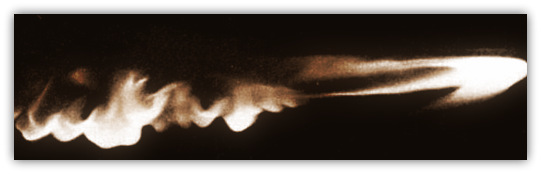
Wildfire
Fatal Accidents 1837
- Carnfield. In October of that year there was an explosion at Carnfield, Alfreton, (Derbyshire) (Coke and Co), and 2 men were killed and 4 others burned.
There was a Davy lamp at the Carnfield colliery office to test for wildfire or firedamp (methane gas), but it was rarely used.
The deeper Carnfield pit working the Deep Soft seam at 130 yards (119m) deep was particularly fiery. The other pit was 112 yards (102m) deep to Top Hard. A 30hp steam-winding engine was used. The headways were 3 feet 9 inches (1.1m) and 3 feet 2 inches (0.98m) high respectively.
- Codnor Park Colliery. On Wednesday morning 11th Jan 1837 a man named Charlesworth was employed to fill up an old pit shaft at Codnor Park Colliery and was about to commence work when he slipped and fell down the shaft and was dashed to pieces.
- Eastwood pit on 27th April 1837 David Bostock was involved in an explosion of wildfire and was transported home some 3 miles from the pit on a board where he lingered for several hours before dying from his injuries.
- Mexboro' a girl named Jane Hodson 15 years old had taken her brother's dinner to a whimsey at Mexboro' when the wind blew her clothes amongst the machinery and she was drawn between the cogs of the wheels that injured part of her thigh (which was nearly torn from her body) and she remained in this dreadful state for about 10 minutes before she was extricated. The deceased lived in great agony from her injuries until Saturday.
- Old Pinxton. Tallow candles were used for illumination underground. In the previous year a boy had been severely burned whilst chasing a mouse with a lighted candle at Old Pinxton pit, when he had been enveloped in ‘wildfire’. John Coke of Pinxton owned both the pits.
- Radford (Lord Middleton), Henry Elson had been an engine driver for some 40 years, the last 18 in the employ of
Lord Middleton. Last Friday he had been at work from 10.30am to 8pm when Sam Winfield another driver left him. It would appear that Elson had stopped the engine for some reason and had gone to do something to the works and whilst climbing over a hot water pipe he had slipped and fallen to the brick floor 7’ 6” (4.57m) below. When found dead the back of his head was leaning on a projecting stone part of the engine foundation and blood was coming from a wound, 11th May 1837.
- Ripley Colliery on 24th Feb 1837 a child aged 3, named Joseph Bradley was burned to death when his clothes ignited whilst standing near a fire on a pit hill.
- Ripley Colliery On the same day at the same pit Thomas Barlow aged 14 died when he fell down the shaft whilst ascending at the end of his shift.
- Ripley Colliery. John Duncan was killed at Ripley on Monday 20th March 1837 when a fall of roof buried him.
- Skegby (John Dodsley), William Shimnel (11) was at work in the pit when a fall of roof weighing 6 or 7 hundredweight killed him. The roof had only been sounded a few minutes before the fall, 10th May 1837
- Skegby (John Dodsley), Edward Buxton (c40), John Gelsthorpe (30) and Samuel Gelsthorpe (8) were all killed as they were going to work at 6.30am. They had fastened themselves in the chains with 2 asses above and had shouted to the whymsey man to lower them down the 100 yards (90m) deep shaft. They had gone down 26 yards (23.8m) when one of the iron caps fastened to the rope broke and let the bolt slip through and they all fell to the bottom the shaft. Buxton had his neck dislocated and his head nearly cut off and his heart and intestines were hanging out of his side and his legs were broken and his body badly smashed. The boy had one leg cut off and the other one nearly. All his teeth had been knocked out and his face jaw and head smashed. John Gelsthorpe had a leg broken and his face badly bruised. The cap that had broken had been welded and was not as thick as the other solid iron caps, 25th Jun 1837
- Selston (Kirkby Fenton), on Saturday morning at 8am the deceased William Kirkland (11) was descending the 150 yards (137m) deep shaft with his brother. At half way the hooks of the ascending chain caught his clothes and pulled him out of the chains and he fell to the bottom of the shaft. He was taken up dead as the back of his head was extensively smashed, his neck and right arm broken and blood was pouring from his ears, nose and mouth. His brother Joseph Kirkland had a narrow escape as the hook caught the bottom of his flannel waistcoat and ripped it up to the pocket hole and pulled him out of the chains and he hung by his hands until the hook broke loose and he sank back into a sitting posture again, 28th Aug 1837
- Watnall (Barber and Walker), Joseph Ward (59) was found burnt to death near the whimsey on Wednesday morning. It is thought that he went into the ash hole to warm himself whilst still in a state of intoxication from the night before and when his clothes got on fire he could not get out. He was so badly disfigured that the only way to identify the body was by the broken leg that he had had for some years, 18th Oct 1837.
Mexboro' Pits
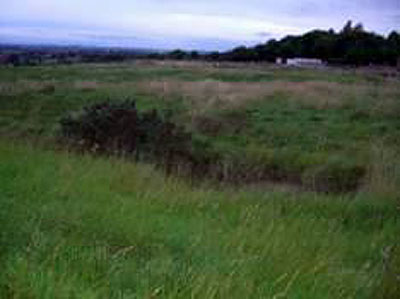
A photo taken by me in 2009 shows the abandoned site of the Mexboro’ pits (Butterley Co).
Note the various types of grasses and acid loving plants / bushes growing on and around the site of an old shaft.
Collieries Sunk or Opened in 1837
- Butterley Park Engine shaft (Butterley Co) Deep Hard 2’ 11” (0.89m) at 148 yards 2’ 10½” (0.88m) (136m)
- Loscoe (Goodwin and Griffin)
- The Earl of Mexborough had taken a lease on coal at Selston where the Butterley Co sank Mexborough (Mexbro’) No1 and 2 shafts to the Top Hard seam at the site. The spelling would vary i.e. Mexboro’, Mexbro’ etc, no doubt as to the pronunciation of the locals. Newcastle (Mundy) near Shipley (Derbyshire) was also put to work around this time to produce Deep Soft and Deep Hard
- Charles Seely sank Shady Birchwood pit.
- A further pit was sunk by Barber Walker and Co at Beggarlee (shown as Beverlee on 1836 map) near Eastwood and was opened in 1838, and at Willey Lane, Underwood, whilst sinking, a Watt Condensing winding engine was put to work by the company, this being the first of its kind in Nottinghamshire.
- Rutland No1 (Pit No3) (Rutland Colliery Co), Ilkeston, was sunk to the Soft coal at 119 yards (109m).
Ibstock Colliery was purchased by the newly formed Leicestershire Coal Co in 1837 following a survey by Willis Bailey stating that the pit was in good order. By November a 70hp engine capable of operating 3 shafts had been installed.
Collieries Closed in 1837
- Awsworth (Awsworth Coal Co)
- Calow Old Furnace (…?)
- Unstone (Geo Mower and others) had 2 tunnel mouths, named Old and New. 1837 works near Oldmoor Wood (Nottinghamshire).
1837 was a particularly bad year for coal, there being a depression in the market |


