Ventilation
 John Riley (39) collier at Tibshelf and Samuel Wainwright (38), served 2 years for a farmer at South Wingfield. John Riley (39) collier at Tibshelf and Samuel Wainwright (38), served 2 years for a farmer at South Wingfield.
Water, gas and weighting began to affect the mines more as they dug deeper.
The natural ventilation from two shafts at some pits although very slow, kept the air from being foul, however there was a reversal of the air current from summer to winter, with a dangerous stale period twice a year. Footrills or adits from the surface accessed the seam and then a shallow shaft would be sunk as an air pit to create an airflow round the workings.
The sketch shows natural ventilation in summer for a pit with 2 shafts and the near sketch shows natural ventilation in winter.
Fatal Accidents 1808 Included
- Pike pit (Lord Middleton) near Bilborough, whilst descending, John Smith and Joseph Banks were killed when a horse working on the surface somehow fell down the shaft onto them. They were both killed, the horse also, Jan 1808 (could be 1800!)
- Greasley pit, Samuel Kirk was damped to death in the pit
- Eastwood, a boy about 10 was descending a shaft at a pit when the ascending corfe caught him and he was toppled over and fell to the bottom of the shaft and was killed. His father was at work in the mine at the time, April 1808
- Wollaton, William Marsden was killed when coals fell on him whilst working at the face June 1808.
Parliament Assassination
  Prime Minister: Spencer Perceval, the only British Prime Minister to have been assassinated (Tory) 1809-1812. Prime Minister: Spencer Perceval, the only British Prime Minister to have been assassinated (Tory) 1809-1812.
Power politics … Spencer Perceval being shot by bankrupt businessman John Bellingham in the lobby of the House of Commons. The only British prime minister so far to have died by assassination. Britain was in deep recession, for which Perceval was blamed; the news of his murder was greeted with jubilation all over London, and soon all over Britain. Bellingham, for the week of life he had left, became a celebrity, almost a hero.
Colliery Sinkings 1809
Hucknall New colliery (Mellers) at Huthwaite was sunk to 47 yards (43m) at the coal shaft and 52 yards (47m) at the bye pit to the Dunsil seam to replace an existing mine – later referred to as Old Hucknall. The shafts lay to the north of Hopkin Lane
Lane pit (Morewood) sunk at Newlands to 44 yards (40m) deep.
1809 Was A Good Year For Coal - And Rates For Coal Hewers' Rose
In 1810 a nine-year-old boy named William Wardle from Eastwood was paid 1s (5p) a day, which was the going rate.
Method Of Working The Coal
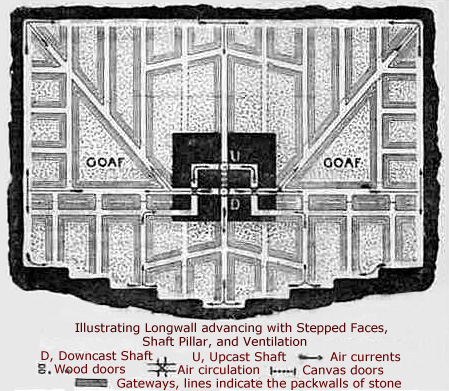 John Farey described the method of working the coal. Either a level driven across dipping measures so as to foot, sole or stool a seam of coal at its base, or a shaft was sunk to the floor of the seam intended to be worked. In the first instance, a stream of cold air would rush in by the sough or water gate, if made of sufficient height and dimensions, and up the first shaft which was sunk, and the work was in condition to be commenced. Sometimes nothing could be done until a second shaft was sunk called a Bye pit, and connected by a thurl or heading with the pumping shaft, when a stream of air would generally circulate down the Pumping shaft and up the Bye pit. But if this did not happen, the Bye pit had to have a fire pan suspended in it, in order to increase the draught, or be treated as a Fire shaft. In the case of foul air still remaining at the bottom of the shafts and in the thurl, if the pumps be made to scatter a part of their water down the shaft from the top, in an extended a sheet as possible, it generally would succeed in expelling such air. John Farey described the method of working the coal. Either a level driven across dipping measures so as to foot, sole or stool a seam of coal at its base, or a shaft was sunk to the floor of the seam intended to be worked. In the first instance, a stream of cold air would rush in by the sough or water gate, if made of sufficient height and dimensions, and up the first shaft which was sunk, and the work was in condition to be commenced. Sometimes nothing could be done until a second shaft was sunk called a Bye pit, and connected by a thurl or heading with the pumping shaft, when a stream of air would generally circulate down the Pumping shaft and up the Bye pit. But if this did not happen, the Bye pit had to have a fire pan suspended in it, in order to increase the draught, or be treated as a Fire shaft. In the case of foul air still remaining at the bottom of the shafts and in the thurl, if the pumps be made to scatter a part of their water down the shaft from the top, in an extended a sheet as possible, it generally would succeed in expelling such air.
The next step was to drive a water level in the coal so that the water would stand in its bottom, with a fall to the Pumping shaft or sough. If the measures were regular and no faults occurred, this level would be straight, whatever the dip of the coal may have. It did not often happen that the Water level could be driven far, for want of air, without carrying at the same time a counter head, counter level or gate, at 3 to 6 or 8 yards (2.75m to 5.5m or 7.5m) from it, up the slope of the coal, and driving bolt-holes or small thurls between them as often as necessary, and stopping up all those previously made, by which means a stream of air would constantly flow along the Level and back to the Bye pit.
In deep pits or in expensive ground to sink it was not unusual to make the Engine shaft large or oval and to divide it by a close partition of boards from top to bottom, by which means, one half can be appropriated to pumping and the descending current of air and the other half to drawing of coals and the ascent of heated and foul air, instead of sinking a Bye pit, and in the night, or when coals are not drawing, a fire pan or a close cover instead of a dome, would convert half of a pit into a Fire shaft, for more effectually ventilating the works for the next day.
Cleat of The Coal Was Important
He pointed out the direction of cleat as explained elsewhere and how the face line must be regulated by the slines, or lengthways joints of the coal, or the expense would be much increased as well as the coals broken small, and much damaged in the operation. In other words he was pointing out that only large lump coal was required to be mined where possible, as there was at that time no market for small coal – my what a difference today, where any coal sent to a Power Station is mixed with up to 15% dirt and all pulverised to fine dust where possible to be used in the ovens.
The direction of the cleat throughout the country, strangely enough, is approxinately 152o south east.
Farey went on to state that the coals in Derbyshire were generally worked on the long way (long benks), the most economical method, and cross gates or thurls begun from the working gate, at 50 yards (45m) or more from the Engine shaft, which was driven, 10, 15 or 20 yards up the slope but more often Jenny gates were driven at 3 or 4 yards (2.75 to 3m) for furnishing a double way to the bank.
The length of the bank or benk depended on the goodness of the roof and could be up to 100 yards (90m). The work began by a set of colliers called Holers, who began in the night and holed or undermined all the bank or face of the coal, by a channel or nick from 20 to 30 inches (0.50m to 0.75m) and 4 to 6 inches (0.10 to 0.15m) high in front, pecking out the holeing stuff with a light and sharp tool called a maundrel or pick or hack, and placing short struts of wood in places where it was likely that the coals may fall. Much of the profit of the seam depended on this action as well as a good roof and in favourable cases, a thin stratum of sloam, spavin or soft dirt, or of soft earth, or soft and bad coal, lies under a valuable seam, and a hard rock or bind covers the coal so that the whole of it can be got. In less favourable cases, the holeing was made in the middle of a seam where there happens to be a soft bat of earth or bad coal, when the labour of wedging up the lower part and the breakage of the whole was much increased, and in the worst cases the holeing had to be done in good coal, chipping and wasting it and at the same time, some of the best coal was obliged to be left for a roof to punch to.
Hammer men or drivers followed and felled the coal by means of long and sharp iron wedges set into the coal at or near the top of the seam and driven by big hammers until the coal was forced down in large blocks, often many yards (metres) long – a dangerous time.
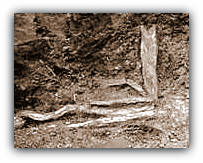 New timber was usually obtained from underwood or plantation thinnings and would have to be transported into the mine to supplement the old timber that if possible would be knocked out, and moved forward to its new position. This recovery of used timber was a dangerous operation and many men were buried when the roof collapsed, usually with dire consequences. It appeared that at Shipley and Apperknowle Common collieries supports were wholly omitted due to an excellent roof, and at a few other pits puncheons were only set where necessary as a precaution! New timber was usually obtained from underwood or plantation thinnings and would have to be transported into the mine to supplement the old timber that if possible would be knocked out, and moved forward to its new position. This recovery of used timber was a dangerous operation and many men were buried when the roof collapsed, usually with dire consequences. It appeared that at Shipley and Apperknowle Common collieries supports were wholly omitted due to an excellent roof, and at a few other pits puncheons were only set where necessary as a precaution!
The broken timbers would have to be left behind, causing some considerable expense.
Cast Iron Props
John Charlton, a most ingenious Mechanic and Coal Agent had invented the cast-iron puncheon, or stauncheons with caps, to alleviate this problem in 1802. They were in use at Adelphi and other collieries being fluted and braced so as to give them great strength and lightness. Where the weight was apt to come on suddenly on the puncheons, such were not used, but packs of square logs or nogs of wood were piled up in place of them. They were able to bear great weights and were easily removed when placed on an inch or to (a few centimetres) of thick holeing stuff or on a soft floor which could be removed by picking at it. The packs or nogs of wood or flat stones were often necessary at the side of the gates, particularly at deep mines such as Donisthorpe where the main gates were supported by brattices or packs of puncheon wood, 4 feet (1.2m) long, laid close to each other, crossing each course, up to the roof. The Rembler followed and hammered the coals into sizeable pieces and the Loaders filled the corves or trams. At the face now a new set of men called Punchers or Timberers set up a row of puncheons about 3 feet apart (0.9m), almost touching the new coal face line, applying a small flat piece of wood (cap lid) or templet at the top of each unless the roof is good. The coals would be transported to the pit bottom eye by Hurriers who dragged the corves, or Gangers who drove asses or ponies to pull the trams. Where only large lumps were mined a sledge was used instead of a corve. Very little small coal was raised as there was no market for it. The Corve men drove the horses, mules or asses, or Hurriers who dragged the corves in smaller work and conveyed them to the bottom of the Drawing shaft, where the Bridger, Bottomer or Hooker-on fastened the corve to the tackling chains and the corve was drawn up the shaft to the top by Wimsey, Horse-gin or Turn-beam.
Onsetter And Banksman
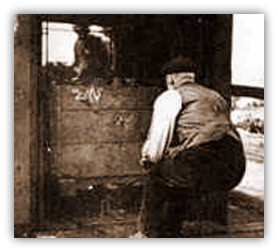 The Hooker on, Hanger on, Bottomer, Bridger or Getter outer (or later term Onsetter) would fasten the wooden box corve or basket corve to the winding rope tackling chains and signal to the winder to raise the same to the surface. In return, an empty vehicle would descend the shaft to replace the full one and so on. The Banksman or Striker at the surface would grab the corve or rope with a bank-hook from the centre of the shaft to the pit bank, pull it over to unload the same on the landing stage or sattle-board, a sliding stage device that was pushed beneath the corve at the pit top to assist in the unloading. However there were many accidents resulting in death as the unfortunates overbalanced and fell down the shaft. The picture shows a more modern banksman pulling tubs off a cage with another pushing at the back. Even so many accidents happened and men or boys continued to overbalance and fall down the shaft. The Hooker on, Hanger on, Bottomer, Bridger or Getter outer (or later term Onsetter) would fasten the wooden box corve or basket corve to the winding rope tackling chains and signal to the winder to raise the same to the surface. In return, an empty vehicle would descend the shaft to replace the full one and so on. The Banksman or Striker at the surface would grab the corve or rope with a bank-hook from the centre of the shaft to the pit bank, pull it over to unload the same on the landing stage or sattle-board, a sliding stage device that was pushed beneath the corve at the pit top to assist in the unloading. However there were many accidents resulting in death as the unfortunates overbalanced and fell down the shaft. The picture shows a more modern banksman pulling tubs off a cage with another pushing at the back. Even so many accidents happened and men or boys continued to overbalance and fall down the shaft.
The corves (or wooden boxes having fixed iron bailor handles over it or in smaller work being slung by 4 chains hooked to the corners) were then dragged to the pit-hill to be stacked to await collection or loaded into trams for the Railway. It was said that a corve held 9 pecks (180lb or 82kg) and in others 2 cwt (240lb or 109kg).
Shaft Signals
Many other accidents occurred due to lack of proper communication. At the shallower shafts the only form of notification for movement would have been by shouting to one another. The method of winding at the shaft was by means of a steam Wimsey, horse-gin or man turn-beam, usually dependent upon the depth.
Tugging on a wire was the first mechanical means of signalling. In fact this system remained in use at the Shonkey Upcast shaft at Teversal until the late 1950s due to the damp foggy atmosphere that affected electrical circuits, and I used this system to wind myself out of the pit on lots of occasions (aged 16 and 17). It was probably, or more than likely illegal to do this, but there was no permanent onsetter and one had to go and fetch the Ostler (Tommy Smith) from the stables if he was available. More often than not he would be busy seeing to the ponies and would refuse to go to the upcast pit bottom, because it was somewhat of a traipse from No1 pit bottom through a couple of air doors that needed ‘Carnera’ to open them! Anyway that was the system for a select few of us staff people riding out of the pit at unscheduled times. You had to give 3 long pulls on the wire using the big handle and hope that the winding engine driver heard the bell or it was convenient for him to go and fetch somebody – phones were unable to be used in the Shonkey pit bottom because of the dampness and they also didn’t seem to exist in the stables! The banksman would then ring 3 and you would wait for ages whilst the cage arrived at the pit bottom.
The solid sided cage was always kept at the pit top because it restricted the airflow when in the pit bottom. When the cage stopped you would pull the wire 3 times, wait a few seconds then pull the wire 3 times again. This indicated man riding. You then pulled the wire once more to give the signal to raise, and then dashed onto the cage getting wet through in doing so, as water from the shaft splashed off the top of the cage like a waterfall, and then dropped the gate behind you. However there was really no panic because the engine man would always wait for at least another minute before engaging the engine. It was a very slow ride and you could almost count the rows of bricks in the shaft.
Of course that system ceased with the tightening up of the regulations etc, with the implementation of the Mines and Quarries Act 1954 from 1st January 1957, and later when a new pit bottom was built some 55 feet (17m) higher up the shaft, proper electrical signals were installed and were only used by an authorised onsetter.
Working The Coal
The workings in the old days advanced from the pit bottom depending on the direction of the slines or joints in the coals and with respect to the water levels driven and the counter level or working gate to extract the coal. In the long benks a cross-gate, a Jenny gate or thurl was begun from the working gate at 50 or more yards (45m) from the engine shaft and gradually extended inbye as the face advanced. Early miners tried to work the coal slightly uphill, following the contours, so that full vehicles were easier to move down hill towards the pit bottom by gravity using hand tramming or pony drawn.
The old method of working by post and stall where vast amounts of coal are left behind or cannot be worked was now dying out in the area, but a system of short benks were worked at Boythorp(e) and Loundsey Green in Chesterfield due to very poor roof conditions.
Cannel Coal
Thin seams of cannel coal sometimes also called branch or sparkle coal was found at Blackwell, Calow, Skegby, Somercotes furnace and Tibshelf pits.
Iron Works
Butterley Co built new ironworks and a forge in Codnor Park. The minerals had been leased from the Rev’d Leigh Hoskins since 1796.
Collieries Closed in 1809
- Calow Old Level (…?)
- Wood Nook (…?)
- Donisthorpe colliery (Mammatt) was closed due to an underground fire.
Fatal Accidents 1809
- Bilborough, Samuel Ellis (?) caught in a Whim Gin wheel ?/1/1809.
Collieries Sunk Or Opened in 1810
- Dronfield (Morton, Drabble and Bennett)
- Bilborough pit (Barber) near Babbington village was renamed Hollywood or Holleywood colliery (was sunk in 1795, and maybe closed and re-opened by a different company?)
- Cockspur near Donisthorpe
- Folly pit (Morewood) 70 yards (64m) deep at Leabrooks
- Whiteley near Ripley was re-opened by Butterley Co, having been closed since 1715
- An attempt to re-open Furnace pit that had been sunk close to the canal failed at this time but would eventually re-open
- First Heather pit in (Leicestershire) sunk about this time, also Lount and Pistern Hill (Leicestershire). William Hill attempted to keep Measham (Leicestershire) working until now and in 1810 Mammott having closed Donisthorpe made an effort to re-open Measham.
Cast iron posts, staunchions or props, invented by John Charlton, and packs or nogs of wood were now used at several pits in Derbyshire at this time. The idea was slow to catch on however as miners were wary of the system.
Pits in North West Derbyshire sunk before this date
- Aspenshaw
- Bank End
- Bugsworth
- Burn’d Edge
- Eaves Knowle
- Lower House
- Moor Top
- Tor Mine
- Warps Moor
- Broadhurst Edge.
Collieries Closed by 1810
- Alton Grange (Leicestershire) or before
- Awsworth mine (Awsworth Coal Co?), (½ mile East of the town)
- Berristow (…?) 2 shafts (1m East North East of South Normanton). There was a cart track leading to the lane to Blackwell. On the site of the pit were a smithy, brick field and kiln. The pit was named after Berristow Farm at the side of the main road (now the A38 from Mansfield to Alfreton). Berristow Place, a row of cottages was adjacent, possibly for the officials for the colliery
- Bramcote (…?) (¾ mile North East of Stapleford)
- Cossall mine, (Lord Middleton) (½ mile North West of the town)
- Donisthorpe (Edward Mammatt)
- Holbrook (…?) (⅓ mile East of town)
- Little Common (…?) (Brampton, 1½ miles West of Chesterfield)
- Lount Old, Earl Ferrers
- Nether Leys (South Derbyshire)
- Overthorpe (…?) (½ mile South West of Killamarsh)
- Ripley
- Robey East Field (Drury Lowe) (1m East of Denby Church)
- Stanfree (or Horsecroft) (East of houses)
- Waterfield (…?), East of Stanton, 1¼ miles West South West of Newhall, (South Derbyshire).
Farey Lists The Following Pits In South Derbyshire / Leicestershire in 1810
- Alton Grange closed prior to 1810
- Blackfordby
- Bretby
- Coleorton east of Coleorton village
- Donisthorpe
- Gosley Waste, Hartshorne
- Hallfields
- Heath End ½ mile west of Staunton Harold closed prior to 1810
- Heather south east of Heather
- Littleworth
- Lount New (Sir G Beaumont) north of Coleorton, working
- Lount Old (Earl Ferrers) north of Coleorton
- Measham
- Milk Hill
- Newhall
- Newhall Park
- Oakthorpe
- Packington ¼ mile south west of Packington closed prior to 1810
- Perkins
- Pistern, Smisby
- South Wood 2 miles north east of Ashby closed prior to 1810
- Stanton
- Staunton Harold south east of Church
- Swadlincote
- Sweet Hill
- Swepston(e) east of Swepstone village working
- Swepston(e) north west of Swepstone village closed prior to 1810
- Warrenhill Furnace, Overseal
- Waterfield
- Woodenbox
- West Foodfield.
|


