Dear Fionn and councillors, MPs and MEP
 Yesterday's UN climate change report indicates the importance of carbon capture Yesterday's UN climate change report indicates the importance of carbon capture
Professor Paul Younger is one of the few (if not thee) expert on the problems posed by possible industrial scale UCG in regard to carbon capture as CO2 is 35% of the UCG output - yet, now he is the director of a UCG company he does not want to capture the CO2 because it would impact on his new inexperienced UCG company (and personal) profit.
How do we know this - there is a loophole that states the carbon must only be captured if the UCG syngas is used for power generation.
director of taxpayer funded UCG company Five Quarter, Professor Paul Younger, who studied the carbon capture problem, has stated publicly
"It would be madness to use the UCG syngas for power generation" - because he knows this forces his company to spend huge amounts of their potential profits to capture the 35% emissions from his company's planned UCG process for your area.
And as it looks highly likely Five Quarter will be the ones to get the licenses in Northumberland and Durham so you will be the first UCG guinea pig area for this unproven technology, which has never been tested near off-shore to be used by a company with no UCG experience who look like they plan to allow the 35% CO2 emissions to pollute your environment.
As a result of this and yesterday's UN Climate Change Report, I have emailed my MP and my MSP yesterday to ask both to challenge both the Westminster and Scottish Energy Ministers to revoke this UK Government UCG "carbon capture loophole" to ensure if UCG goes ahead all CO2 must be captured by the UCG company - regardless of how the resultant syngas is used.
I have also requested they also demand every UCG licence be revoked until the process undergoes small scale trials on which, like Australia, the process can be evaluated in the UK to allow councils and government to assess the environmental impact and the legislation required to ensure the correct safety and environmental restrictions are in place before any industrial scale UCG processes can be undertaken both onshore and near offshore in the UK
Australia has undertaken trials and banned commercial UCG as a result. They have already put new legislation into effect.
Has our government asked for copies of the trial results and studied the legislation put in place in Australia - especially as Linc Energy has shut their trial in Australia because of the legislation and is heading to the UK - where it already has a "memorandum of understanding" with the UK Coal Authority.
Councillors cannot be expected to ensure they have effective legislation in place if the UK has not conducted small scale UCG trials and assessed the impact of unproven technology to be used on an untested process from start to finish. Australian trials are still not finished - and all trials have been shut down.
 It is the government's responsibility to ensure small scale trials are undertaken before any licenses are issued which is exactly why all UCG licenses should be revoked It is the government's responsibility to ensure small scale trials are undertaken before any licenses are issued which is exactly why all UCG licenses should be revoked
I'm sure you understand the logic and the requirement for all UCG licenses to be revoked until government funded trials can take place to assess this untried process from start to finish, in a small scale, to identify the issues and the legislation requirements.
This UN climate report is a very good vehicle to highlight the governments secret UCG plan and open a public debate regarding should UCG be banned if not who should profit the entire nation or the 1% and if UCG goes ahead should carbon capture be compulsory regardless how the resultant syngas is used
Just my personal views which I hope again you find of use to the current situation regarding the UCG plans for Durham
Mel Kelly
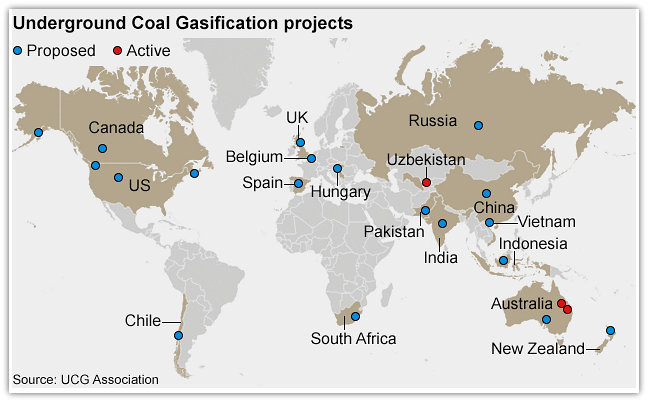
Coal gasification can help address local pollution problems that have in recent months brought parts of China to a virtual standstill.
But there are two big problems. First, coal gasification actually produces more CO2 than a traditional coal plant; so not only will China be using more coal, it will be doing so at a greater cost to the environment.
As Laszlo Varro, head of gas, coal and power markets at the International Energy Agency (IEA), says: "[Coal gasification] is attractive from an economic and energy security perspective.
"It can be a nice solution to local pollution, but its overall carbon intensity is worse [than coal mining], so it is not attractive at all from a climate change point of view".
Indeed a study by Duke University in the US suggests synthetic natural gas emits seven times more greenhouse gases than natural gas, and almost twice as much carbon as a coal plant.
The second problem is water use. Coal gasification is one of the more water-intensive forms of energy production, and large areas of China, particularly in the western parts of the country that would host new gasification plants, already suffer from water shortages.
Mr Varro says a recent IEA report concluded that coal and coal gasification plants would use "quite a substantial portion of the available water in China". |


