|
High Park Colliery (Moorgreen)
High Park Colliery Merged With Moorgreen 1950
Inquest Reports From Newspapers -
Re Nottinghamshire Fatal Accidents
Nottinghamshire Guardian - Friday 17 January 1868
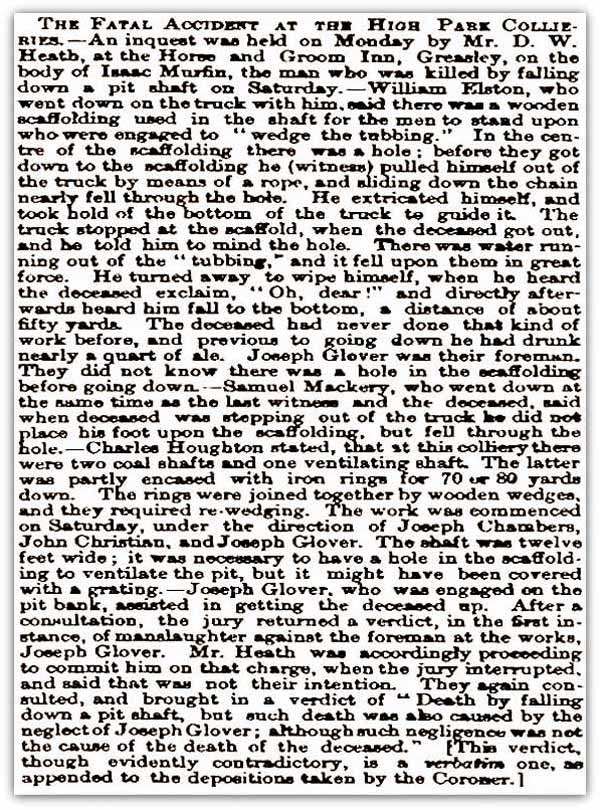
Isaac Murfin

Nottinghamshire Guardian Friday - 06 January 1865
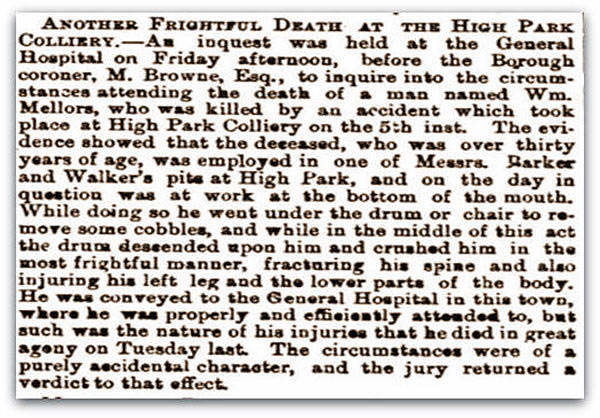
William Mellors
Nottinghamshire Guardian Saturday - 07 July 1876
Edward Morley, Abel Martin, and William Lindsey
(Transcript below)
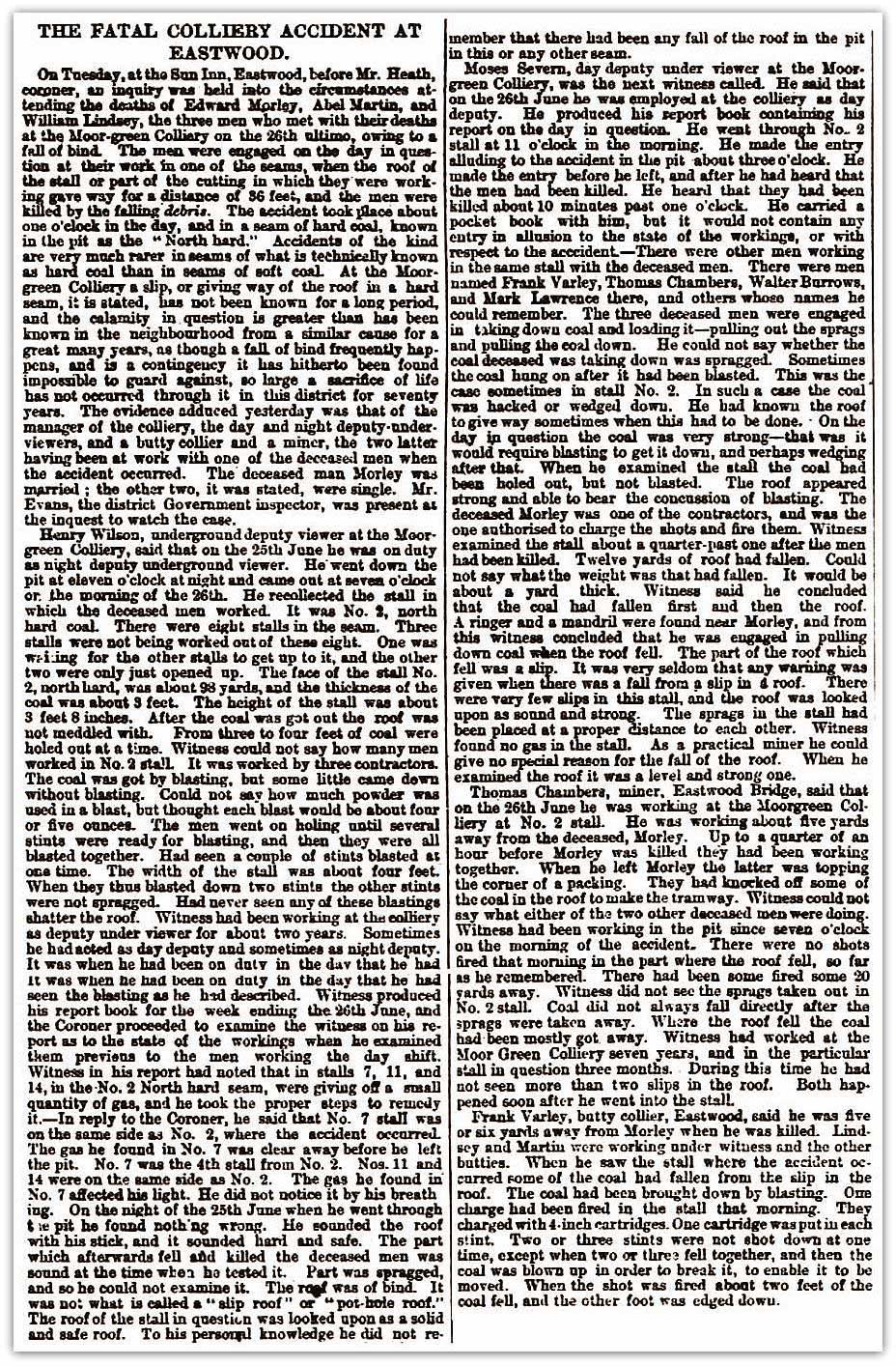
THE FATAL COLLIERY ACCIDENT AT EASTWOOD
On Tuesday, at the Sun Inn, Eastwood, before Mr. Heath, coroner, an inquiry was held into the circumstances attending the deaths of Edward Morley, Abel Martin, and William Lindsey, the three men who met with their deaths at the Moor-green Collier on the 26th ultimo, owing to a fall of bind. The men were engaged on the day in question at their work in one of the seams, when the roof of the stall or part of the cutting in which they were working gave way for a distance of 36 feet, and the men were killed by the falling debris. The accident took place about one o'clock in the day, and in a seam of hard coal, known in the pit as the "North hard." Accidents of this kind are very much rarer in seams of what is technically known as hard coal than in seams of soft coal. At the Moor-green Colliery a slip, or giving way of the roof in a hard seam, it is stated, has not been known for a long period, and the calamity in question is greater than has been known in the neighbourhood from a similar cause for a great many years and though a fall of bind frequently happened, and is a contingency, it has hitherto been found impossible to guard against, so large a sacrifice of life has not occurred through it in this district for seventy yean. The evidence adduced yesterday was that of the manager of the colliery, the day and night deputy-under-viewers, and a butty collier and a miner, the two latter having been at work with one of the deceased men when the accident occurred. The deceased man Morley was married; the other two, it was stated, were single. Mr. Evans, the district Government inspector, was present at the inquest to watch the case.
Henry Wilson, underground deputy viewer at the Moor-green Colliery, said that on the 25th June he was on duty as night deputy underground viewer. He went down the pit at eleven o'clock at night and came out at seven o'clock on the morning of the 26th. He recollected the stall in which the deceased men worked. It was No. 2, north hard coal. There were eight stalls in the seam. Three stalls were not being worked out of the eight. One was waiting for the other stalls to get up to it, and the other two were only just opened up. The face of the stall No. 2, north hard, was about 98 yards, and the thickness of the coal was about 3 feet. The height of the stall was about 3 feet 8 inches. After the coal was got out the roof was not meddled with. From three to four feet of coal were holed out at a time. Witness could not say how many men worked in No. 2 stall. It was worked by three contractors. The coal was got by blasting, but some little came down without blasting. Could not say how much powder was used in a blast, but thought each blast would be about four or five ounces. The men went on holing until several stints were ready for blasting, and then they were all blasted together. Had seen a couple of stints blasted at one time. The width of the stall was about four feet. When they thus blasted down two stints the other stints were not spragged. Had never seen any of these blastings shatter the roof. Witness had been working at the colliery as deputy under viewer for about two years. Sometimes he had acted as day deputy and sometimes as night deputy. It was when he had been on duty in the day that he had seen the blasting as he had described. Witness produced his report book for that week ending the 26th June, and the Coroner proceeded to examine the witness on his report as to the state of the working when he examined them previous to the men working the day shift. Witness in his report had noted that in stalls 7, 11, and 14, in the No. 2 North hard seam, were giving off a small quantity of gas, and he took the proper steps to remedy it .—In reply to the Coroner, he said that No- 7 stall was on the same side as No. 2, where the accident occurred. The gas he found in No. 7 was clear away before he left the pit. No. 7 was the 4th stall from No. 2. Nos. 11 and 14 were on the same side as No. 2. The gas he found in No. 7 affected his light. He did not notice it by his breathing. On the night of the 25th June when he went through the pit he found nothing wrong. He sounded the roof with his stick, and it sounded hard and safe. The part which afterwards fell and killed the deceased men was sound at the time when he tested it. Part was spragged, and so he could not examine it. The roof was of bind, it was not what is called a “slip roof" or “pot-hole roof". The roof of the stall in question was looked upon as a solid and safe roof. To his personal knowledge he did not remember that there had been any fall of the roof in the pit in this or any other seam.
Moses Severn, day deputy under viewer at the Moor-green Colliery, was the next witness called. He said that on the 26th June he was employed at the colliery as day deputy. He produced his report book containing his report on the day in question. He went through No. 2 stall at 11 o'clock in the morning. He made the entry alluding to the accident in the pit about three o'clock. He made the entry before he left, and after he had heard that he men had been killed. He heard that they had been killed about 10 minutes past one o'clock. He carried a pocket book with him, but it would not contain any entry alluding to the state of the workings, or with respect to the accident—There were other men working in the same stall with the deceased. There were men named Frank Varley, Thomas Chambers, Walter Burrows and Mark Lawrence there, and others whose names he could remember. The three deceased men were engaged taking down coal and loading it—pulling out the sprags and pulling the coal down. He could not say whether the coal deceased was taking down was spragged. Sometimes the coal hung on after it had been blasted. This was the case sometimes in stall No. 3. In such a case the coal was hacked or wedged down. He had known the roof to give way sometimes when this had to be done. On the day in question the coal was very strong—that was it would require blasting to get it down, and perhaps wedging after that. When he examined the stall the coal had been holed out, but not blasted. The roof appeared strong and able to bear the concussion of blasting. The deceased Morley was one of the contractors, and was the one authorised to charge the shots and fire them. Witness examined the stall about a quarter-past one after the men had been killed. Twelve yards of roof had fallen. Could not say what the weight was that had fallen. It would be about a yard thick. Witness said he concluded that the coal had fallen first and then the roof. A ringer and a mandril were found near Morley, and from this witness concluded that he was engaged in pulling down coal when the roof fell. The part of the roof which fell was a slip. It was very seldom that any warning was given when there was a fall from a slip in a roof. There were very few slips in this stall, and the roof was looked upon as sound and strong. The sprags in the stall had been placed at a proper distance to each other. Witness found no gas in the stall. As a practical miner he could give no special reason for the fall of the roof. When he examined the roof it was a level and strong one.
Thomas Chambers, miner, Eastwood Bridge, said that on the 26th June he was working at the Moorgreen Colliery at No. 2 stall He was working about five yards away from the deceased, Morley. Up to a quarter of an hour before Morley was killed they had been working together. When he left Morley the latter was topping the corner of a packing. They had knocked off some of the coal in the roof to make the tramway. Witness could not say what either of the two other deceased men were doing. Witness had been working in the pit since seven o'clock on the morning of the accident. There were no shots fired that morning in the part where the roof fell, so far as he remembered. There had been some fired some 20 yards away. Witness did not see the sprags taken out in No. 2 stall. Coal did not always fall directly after the sprags were taken away. Where the roof fell the coal had been mostly got away. Witness had worked at the Moor Green Colliery seven years, and in the particular stall in question three mouths. During this time he had not seen more than two slips in the roof. Both happened soon after he went into the stall.
Frank Varley, butty collier, Eastwood colliery said he was five or six yards away from Morley when he was killed. Lindsey and Martin were working under witness and the other butties. When he saw the stall where the accident occurred some of the coal had fallen from the slip in the roof. The coal had been brought down by blasting. One charge had been fired in the stall that morning. They charged with 4-inch cartridges. One cartridge was put in each stint. Two or three stints were not shot down at one time, except when two or three fell together, and then the coal was blown up in order to break it, to enable it to be moved. When the shot was fired about two feet of the coal fell and the other foot was edged down.
William Wesson, Eastwood, manager of the Moorgreen Colliery, said he knew the seam in question. He had not had occasion to go into the stall where the accident occurred for some weeks. The plan he produced of the workings was from measurements made since the accident. All the coal appeared to have been gotten except where Morley was, and there there was about a foot of coal. This would be the coal which the last witness said Morley was wedging down. When coal stuck very fast to the roof, wedging or ringing were the only means to get it down. The slip would be over the coal Morley was wedging, and so he could not see it. The slip might be said to have been covered by a small piece of coal.—In reply to the Coroner, the witness said it would be a very difficult matter to suggest anything which could obviate each accidents in the future. The roof which had given way had been regarded as one of the safest. It was hard coal, and soft coal was always considered more dangerous than hard coal. In the course of his experience he had never seen such a slip as the one in question in a bank of hard coal. The witness Varley had made a mistake in saying that after coal had fallen it was blasted to break it up. Such a thing was never done. There was nothing which he (witness) could suggest as a remedy for such accidents. It was the first accident of the kind they had had in the workings for eight years. They had nearly 400 men employed in working the hard coal, and 250 working the soft coal. They had something like 3,000 yards of coal in the workings.
The Coroner then addressed a few observations to the jury. He pointed out how desirable it would be if, as the outcome of the inquiry, any means could be suggested by which accidents of a similar character could be prevented in the future. He alluded in terms of praise to Mr. Wesson the manager of the Moorgreen Colliery, but pointed out how under the best management such accidents could not be provided against, and remarked en passant that so many lives had not been lost through a falling of bind for more than 70 years. In conclusion Mr Heath said there could be no doubt that the occurrence was a simple and pure accident.
The jury, having been left for a short consultation, returned a verdict of accidental death, in accordance with the evidence.
Nottinghamshire Guardian - Friday 17 August 1866
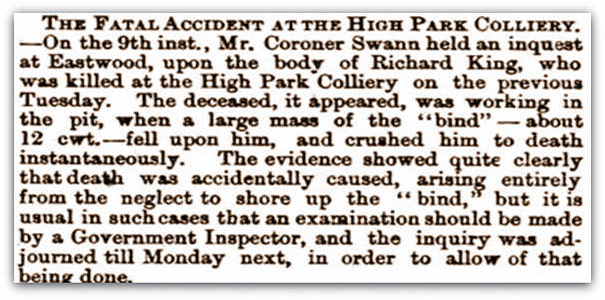
Richard King
|