Oaks Colliery Explosion
12th December 1866
Matthew Hague told the Inquest: "I found the air turned upon us, and we "revolted" again. That is, we were sucked backwards and forwards in consequence of the explosion. I knew this, for I am one of the survivors of the explosion twenty years ago. It seemed as if there was an explosion already upon us. The third "suck" was stronger than the first. William Sugden was there, and said, "We are all done, lads." He then ordered us back. Barker is his name, but he is called William Sugden. I shouted to every one to do the best they could for themselves.
They then left me and William Sugden, and I got into a pump hole in a minute or two preparing for a blast, and expecting another explosion every minute.
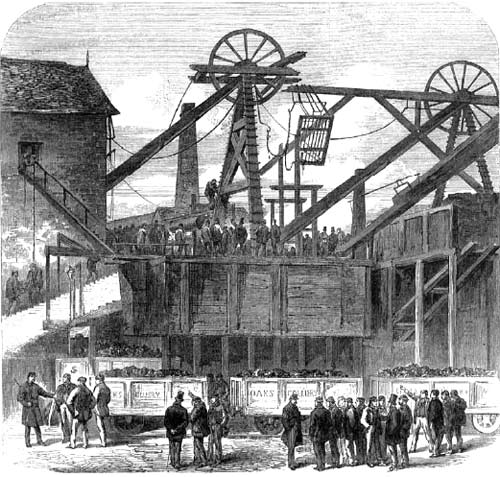 We bade each other "good-bye." After staying a few minutes and finding it was a deal better I said, "Barker, it is a deal better, let us away to the bottom." He said "Is it?" and we went on to the pit bottom.
I never stopped anywhere except to speak to Adam Fletcher, who was in a little cut made in the back of the travelling road for men and horses to go through. I made to the pit bottom as fast as I could, and found Mr Tewart there, together with all the men that had been with us. I made a report to Tewart as to what I had felt. About eight or ten minutes after I got out to the top another very severe explosion occurred. That was about four or five minutes to nine."
Around the pit head men were tossed "one over the other" and "strong men cried like children".
The cage had been blown into the headgear but was quickly disentangled and lowered to the bottom; when they raised it a few minutes later it was empty. 27 rescuers were still in the mine.
About 7:40pm the Oaks exploded for a third time, smoke and then flames came from No 2 Shaft "the mine was well and truly on fire". All hope was now gone.
Then, at about 4:30 on Friday morning, a bell "was definitely heard to ring" in No 1 shaft. A bottle of brandy and water was lowered and when the rope was hauled back the bottle had gone. Feverously a makeshift pulley with a tub for a cage was got ready and Thomas Embleton and John Mammatt courageously made a hazardous decent into the unknown.
They found a sole survivor, Samuel Brown. He had been in a rescue party with Barker, Hoyland and Young. They had gone down the pit about 7 o'clock on Thursday morning alarmed by the "sucking" they had gone to a place known as the "lamphole" and while they were resting there the second explosion took place. Somehow Brown had survived and eventually "made his way to number 2 shaft where he found a large fire and resignedly sat down. Fortunately he fought off the apathy with traditional Yorkshire composure. 'This will not do; I must seek summat." Then he struggled through the darkness to the bottom of number 1 shaft and rescue.
At a meeting, held the same day at The King's Head in Barnsley, it was decided, by Colliery Viewers and the Government Inspector, that nothing further could be done, the mine was well alight and the only option was to seal it to contain and extinguish the fire.
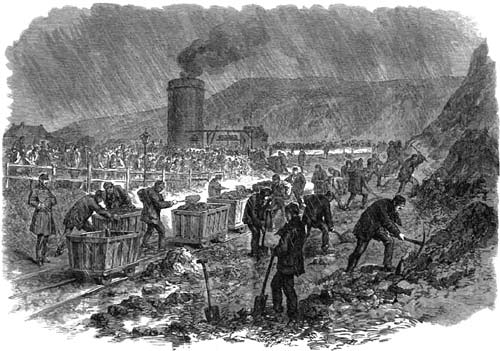 On 17th December they set about sealing the shafts. Checks were made hourly from 30th January until 5th November 1867 when it was deemed safe to re open the shafts. The miners went back to work; but eighty bodies had not been recovered from the pit and occasionally bones were found,
"a skull or a piece of leg bone, and we sent them up to the top, but nobody claimed them and they were buried."
What caused the explosion will never be known. In his report the Government inspector, Joseph Dickinson, stated "one could virtually rule out faulty or unlocked safety lamps at this well managed mine”. Opinion is that blasting in the New Stone Drift; an area considered to be safe, fired an odd pocket of firedamp and triggered the explosion.
The Oaks Pit "was considered a well appointed and efficiently run mine". It was certainly better than some.
Twelve days before the explosion the men had called a meeting with management to
"complain about a weak point in the ventilation".
At the Inquest William Gibson said that he "had worked at the Oaks for four or five years and had left on the Saturday before the explosion" and "that at that meeting (twelve days before) Andrew Barker had stated that on the previous night the gas had fired at his lamp, and he had been 'knocked up' in about three hours and a half. Mr Dymond said that Barker must have been "beering," and, having got a harder job, had complained." Also "While I worked in the pit the ventilation was very bad at my place. My master, Andrew Barker, complained of the gas. I was not present when he did so." I left the Oaks because I could not stand the heat. Barker was my master.
 I said to him I could not stand the heat, and he said, "Very well, my lad will do for me."
Between the 12th and the 18th of December there were 17 explosions at the Oaks.
When the names of the victims were finally posted a total of 361 men and boys had been killed in the Oaks that December, 27 of these were volunteers. For nearly fifty years this was the worst mining disaster in Britain.
Ten of those killed were of the Barker family of Ingleton.
This is their story and is told from their perspective, using extracts from the Inquest and the newspaper reports and illustrations of the time.
James Barker was aged 50. He had been born in Ingleton the son of a miner who had worked all his life in the mines. He had nine children and three of his sons died in the Oaks.
- William aged 16
- Andrew aged 19
- Thomas aged 26
Thomas had also moved to Holye Mill before 1861 and was married and had one child. His body was found with those of his brothers.
Andrew Barker was 46 and born in Ingleton and a cousin of James. By 1858 the family had moved to Hoyland near Barnsley and in1861 they were living in Oak Row, Hoyle Mill, next to the Oaks Pit. He had 6 children; Richard aged14 died with him died the Oaks.
George Wilson Barker was Andrew's brother. He had left Ingleton a few years before to work in the mines in Derbyshire and Nottinghamshire before going to Barnsley. He had 5 children. He had been searching for his 2 boys, Andrew aged 14 and George aged 13 when he 'failed' in the bad air. His 2 boys died.
George Borrowdale aged 49 was one of the first survivors brought out. He had been born at Westhouse near Ingleton and had married James's sister, Nancy. Nancy died early in 1866.
They had 5 children. Their daughter Jane had married Richard Oakley Nichols aged 29 in1864. Richard died in the Oaks, George died of his injuries.
Robert Remington was another Ingletonian who died that day. His Father Richard survived, he had not been well so had not gone to work.
The Barkers and Remingtons were well known mining families in Ingleton from at least the 1770's.
An interesting postscript to this story is that James Barker, great great grandfather of the author and a nephew of George, Andrew and James, became the owner of the Ingleton Collieries and regarded by some as the 'saviour of the Ingleton Coalfield'. In his will after his death in 1915 he named Henry Cawood Embleton, a friend and a gentleman, as one of his trustees. This was the son of Thomas Embleton who made the perilous descent in to the Oaks to rescue Sam Brown.
Steve Barker |


