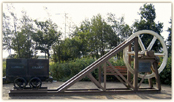
The Lindsay Colliery was at Kelty, about three miles north of Cowdenbeath
(The Inquiry )
The inquiry which lead to the report of the circumstances and causes of the disaster was conducted by Sir Harold Roberts, C.B.E., M.C., B.Sc., and presented to The Right Honourable Lord Mills, K.B.E., Minister of Power in August 1958.
After the disaster the area was inspected by Mr. F.S. Pollard, H.M. Senior District
Inspector of Mines and Quarries and representatives of all other interested parties. The only trace of firedamp was in a roof cavity at the extreme left hand corner of the face. There were only a few signs of visible violence at the outbye end of the No.3 main gate, the gearhead of the gate conveyor had been moved about 2 feet inbye and further inbye the conveyor structure had been moved. The air crossing at the No.4 intake gate was also damaged.
The waste drawing seemed to have been completed and there was a sylvester lying in the No.2 waste. The main haulage rope on the coal cutter had been newly extended and the control handle was in a position normally used for inching which suggested that they were tightening the rope at the time of the explosion. A drilling cable was seen to be hanging on hooks in the tail gate about 15 yards back from the face. There was also a deputy's re-lighter lamp hanging up in that gate. Shot firing exploders and shot firing cables were found hanging up in both gates and in various places Mr. Pollard found a total of 15 four-ounce cartridges of explosives, some cut in half concealed under stones.
A further inspection was made the following morning by Mr. C. Sharpe, H.M. District Inspector of Mines and Quarries and Mr. W. Linton, overman. They searched specifically for anything that might have cause the ignition of gas. They started at the intake road of the No.3 Unit and at the third refuge hole they found a spent match and others along the intake road inbye and cigarette butts on the roadway. On the face they found a spent match at the foot of the No.4 pack. This was near the place that the rescue brigade found a whole cigarette and he found butts in abundance and an empty cigarette packet in the return road.
When the bodies of the men were brought to the surface, police officers examined their clothing and in three cases found contraband:-
1) an empty cigarette packet another packet containing a partly smoked cigarette another party smoked cigarette and three spent and four live matches.
2) a cigarette packet containing one cigarette one loose cigarette and three matches
3) a small tin containing a partly smoked cigarette.
Sir Harold Roberts came to the following conclusions-
1) the initial cause of the explosion was the ignition of firedamp on No.3 Unit by a match struck for the purpose of smoking
2) the firedamp came from the waste in the vicinity of No.3 Pack over a relatively short period, probably as the result of strata movement following drawing off operations
3) owing to the layout, inclination and system of ventilation, the velocity of the air was not high enough to prevent the accumulation of a dangerous quantity of gas even if the rate of emission was only moderate.
4) the primary explosion of firedamp was extended along the intake gate by the explosion of coal dust derived mainly from the transfer point and from the conveyor and
5) it was common knowledge that smoking was widely practised."
The Inspector made the following recommendations-
1) (a) before deciding on the system of ventilation for a steeply inclined face, a careful analysis should be made of the particular circumstances. The National Coal Board should issue instructions to this effect, together with advice about the factors involved and the precautions to be taken.
(b) Conditions on such faces now in operation should be reviewed on the same basis.
2) (a) The National Coal Board should investigate the way in which their directive dealing with dust barriers is carried out, and should take the opportunity of reminding all management of the need to minimise the deposition of coal dust on conveyor roads, and to clear up systematically any that may accumulate.
(b) The National Coal Board should consider whether the terms of their directive on dust barriers are still appropriate, having regard to recent work on the operation of such barriers.
3) (a) The National Union of Mineworkers should combine locally and nationally to devise means of ensuring that workmen use firedamp detectors.
(b) All officials in the line of management should be required to carry firedamp detectors when visiting parts of the mine to which Part III of the Coal and Other Mines (Ventilation) Regulations, 1956, applies.
4) Although the jettisoning of explosives is not causally connected with this explosion, the practice is potentially dangerous and efforts to stop it should be intensified. In particular, cross-checking of the various statutory records should be enforced.
5) Provision for snap searches, i.e. searches carried out in the mine working without warning, should be incorporated in every system approved under Section 66 (2) of the Mines and Quarries Act, 1954.
6) Finally, I will repeat what I said at the end of the Inquiry:-
"I must join in the appeals about contraband. The practice of smoking in safety lamp mines is not confined to Lindsay. The people who indulge in it are not being brave or cleaver but are, in fact, showing an utterly irresponsible, callous and selfish disregard for the lives of their fellows and the happiness of friends and relations. The possible consequences are so appalling that I appeal to the whole of the mining community, management, Unions, officials, workmen, and if I may, to their womenfolk, to try to stamp out this evil practice." |