1943 - Page 2
Strike in Nottinghamshire
There was a strike at Nottinghamshire pits from 13th -18th September 1943 (24,000 men), over pay rates? This was an unusual case as the Nottinghamshire miners were fairly placid so it must have been serious because withdrawing labour during the War was tantamount to treason.
 Wild Catters at Eakring Oilfield Wild Catters at Eakring Oilfield
In February 1943 a team of 43 American oil workers from Texas and Lousiana had arrived in Nottinghamshire to develop the Eakring oilfield to help with the War effort as supplies were running extremely low due to constant raids by the enemy on ships bringing oil from America and Iran. Following top secret meetings with Winston Churchill who was unaware of the Eakring oilfield, an envoy Mr Southwell (from Southwell) was sent to Oklahoma in America to ascertain whether help could be available. Eventually help was given, and drillers brought over from the USA as well as their expertise in drilling, all variety of equipment and collapsible drilling rigs that could be erected and ready for drilling in a few short hours whereas the English drillers took 2 or 3 weeks to build their rigs, and neiher could they drill as fast as the Americans. The equipment was given free but wages were to be paid by the company. However there were quite a few holes drilled producing oil prior to their arrival. The oil had been discovered in 1939 in the dome of the Eakring anticline with No1 well striking the oil at 1,912 feet (583m) deep. Duke’s Wood, planted in 1700 had been acquired by Lord Savile of Rufford Abbey in 1860. The Petroleum Production Act of 1934 allowed drilling for oil. The D’Arcy Exploration Co purchased Duke’s Wood in 1938 but by 1941 the British Government had set D’Arcy a target of 100,000 tons of oil per year. This was not being achieved. The Americans and their equipment were shipped over from the States in 3 different boats in case of being sunk by a German U boat. In 1943 the ‘Wild Catters’ or ‘Rough Necks’, residing at Kelham Priory with the Monks, on a 12 months contract from February 1943 to March 1944, (when they returned home, where they were then elegible for army service), sank 106 wells, producing 3,000 barrels a day (40 gallons to a barrel). It was one of the best kept secrets of the War as nobody thought there was oil under Sherwood Forest. The oil was pumped into tanker wagons and shunted into Bilsthorpe Colliery sidings only a short distance away, before being sent to the prescribed destination.
Unfortunately one young driller was killed when he fell off the 200 feet (61m) high rig. There were many other accidents among the drillers, the less experienced ones losing fingers or toes after releasing the rods drawn out of the holes using stilsons to break the seals and when lowering them to the floor to be stacked in the derrick. 169 holes would be drilled at Duke’s Wood altogether but curtailing the development of Bilsthorpe Colliery in that direction. The oil was of exceptional good quality, and was refined for use in the Rolls Royce Merlin engines of Spitfires during the War. A German spy plane had taken a photograph of the site during the War and a raid was made, but the village of Edingley nearby was bombed instead as the raiders had mistaken the village for the oilfield. Oil would be pumped down the pipeline PLUTO (pipeline under the ocean) from the Isle of Wight to Normandy following the invasion of France in 1944. By 1945 the East Midlands oil wells would have produced a total of 3,520,553 barrels of oil.
It was in 1840 that the distillation of kerosene from petroleum was discovered and in 1859 the first modern oil well was drilled. As mentioned earlier it was oil seeping into coal workings at Riddings in Derbyshire that had created Young’s Paraffin and that had resulted in the first inland oil well in Britain being drilled not too far away at Hardstoft, near Tibshelf, on the Brimington anticline in 1918. This gave the concept of oil being discovered in the tops of anticlines and the Eakring anticline was thought to be a good bet, and it was. Seismic surveys are carried out in order to discover the location of the oil and several oilfields are producing well today in 2014. It was noted that should a hole run dry or stop releasing gas then ‘hydro-fracking’ with water under high pressure was carried out to release gas from the strata as early as 1959. Furore in 2013 regarding proposed fracking near Blackpool where an area of gas sufficient to supply Britain for years was stopped under protest as it was assumed (being a new idea) that water, chemicals etc forced down holes would result in pollution of the water table and cause earthquakes etc. Fracking has been carried out in Britain for 55 years (2014), unknown to most people, without any problems and horizontal holes were drilled by lowering a tool down the vertical hole to bend the hole horizontally. This was a different kind of fracking however by only using water under high pressure to rejuvenate wells also. As yet it is an unknown factor as to whether the use of certain types of chemicals to break down strata will have detrimental affects in the future, on the water table etc. The USA has thousands of fracking holes, releasing gas in huge quantities lowering the price. This led to a major drop in the price of coal (registered in $ on the open World market) in 2014, leading to the death of the deep mine British coal industry.
I had prophesised this many years before as is documented earlier.
The North East Leicestershire Coalfield which would later include Asfordby was discovered in 1943 whilst drilling for oil in the Plungar field.
Sea Gem
Kevin Topham (85 years of age in 2014) an ex Royal Airforce bomb disposal airman and later a driller for Anglo Iranian and BP (British Petroleum) and latterly Curator of
the Oil well museum at Duke’s Wood, Eakring (refer to 2017) outlined to me the
various aspects of the job. North Sea oil and gas was first discovered in 1965 from
the drilling platform of Sea Gem by drillers, some of whom came from Eakring and
Mansfield (Mafia). This rig had been used in the warm waters of Saudi Arabia for 6
years before being towed to the cold water of the North Sea. The legs of the rig were
welded and extended 200 feet (61m) to account for the deeper water. On Christmas
Day 1965 the rig collapsed and 15 of the crew were lost, probably all freezing to
death in the cold sea. No ‘May Day’ emergency call was sent as the radio shack had
gone under and it was only by chance a passing freighter spotted the disaster and
sent for the RAF Rescue who arrived some 2 hours later. There was only one
lifeboat for 50 people and that slipped overboard and was lost and some including
Kevin was fortunate in escaping in a second inflatable pod with 15 others. The first
pod had gone overboard empty. It was proven that the legs on the rig had fractured
at the welds and when tested the legs shattered into many pieces due to the change
of water temperature.
A further disaster was the fire on Piper Alpha Rig later, again tragically with the loss
of life.
Drilling like mining is a very dangerous industry. Many minor accidents have
happened such as dropping the drilling pipe on a foot or chopping several fingers off
when unscrewing pipes etc.
It is known that the coal seams do extend under the North Sea and into the
Continent and have been proven by other exploratory drill rigs, one of which was
purchased by the NCB in the 1970s.
This rig was used to prove seams and depths below the sea bed for pits in the North
East such as Ellington and Easington. Workings would extend over 6 miles from
the shore.
New Coalfield Found
The North East Leicestershire Coalfield which would later include Asfordby was discovered in 1943 whilst drilling for oil in the Plungar field.
Pithead Baths
Pithead baths were opened at Shireoaks (Shireoaks Colliery Co) (North Nottinghamshire).
First Holidays With Pay
The first national holidays with pay for one week were awarded in November 1943, and in 1944 the rate for adults over 21 was £5 5s 0d (£5.25), for 18 to 20 year olds £4 4s 0d (£4.20) and under 18 years £3 3s 0d (£3.15).
Collieries Sunk or Opened in 1943
- Amber drift (Edwin Glossop) Pentrich Lane End, Low Main headings, 4’ 1” (1.24m) coal
- Merry Lees drift (Leicestershire) (Desford Coal Co Ltd) developing in Lower Main coal
- Wheeldon Mill No2 (H Gaunt) Brimington, sinking continued
- Wingerworth (A Hardy) Wingerworth, Deep Hard developed. (4)
Colliery Closures in 1943
- Birley Lane or Dent Main No2 (Dent Main Colliery (1924) Ltd), Parkgate or Deep Hards, coal 8” (0.20m), dirt 1” (0.02m), coal 3’ 2” (0.97m), dirt 1” (0.02m), coal 1’ 8” (0.51m), met old works in lease area, 2 adits 1939 and 1940, Surveyor A Green (1127) for Fennell, Green and Bates, 9 Sep 1943
- Bromehead (Bromehead Colliery Ltd) Marsh Lane, abandoned June 1943
- Caulton Drift (E Glossop), Ridgeway, 8/2, Alton or Belper Lawn, finished 9 Aug 1943 2 adits, 7 shafts, met old hollows, uneconomic, water up to ground level at mouth of 1in3 footrill, water lodges in both seams, HL Jackson Surveyor (502)
- Furnace Hill 2 (Furnace Hill and Renishaw Park Collieries Ltd.) Low Main - 1943
- Giltbrook (Giltbrook Colliery Co Ltd), Awsworth, Deep Hard was abandoned
- Grange No3 (Oakwood Grange Colliery Co Ltd), Cossall, Deep Soft, Jan
- Hazel Ridge (Hazel Ridge Colliery Ltd), Temple Normanton, 2/1, High Hazel 3’ 0” (0.91m), full dip 1in3, old works adjacent, 1 adit Mr Hemmington’s old works and shaft which was used, and Mr Hardy’s old works, worked through. 2 new adits driven and stone head 1in2.5 through old works but found no coal, June; abandoned 29 Dec 1943, Surveyor Arthur D Marriott (918)
- Hill Side (T Wragg and Sons Ltd) Swadlincote, Ell seam and fireclay abandoned Jan
- Holbrook No2 (Norwood), (J and G Wells) Flockton discontinued June 1943
- New Horsley (Pickbourne and Hawkins) near Horsely Hall, driving through old hollows, workings unprofitable
8 Oct 1943
- Marsh Lane (A Beresford), Eckington, Parkgate, Jan
- Minsky or Willesley (Moira Colliery Co Ltd) Block or Jack seam 3’ 9” (1.14m), 6 Aug 1943, Surveyor FH Liptrot (182 dated 22 Jul 1915)
- Moorside, 3 adits, abandoned Oct 1943, surface level 424 ft (129.2m)
- Norwood (J and G Wells Ltd) Eckington, Deep Soft or Flockton seam abandoned June, E446575 N381838
- Packington (Packington Coal and Clay Co) Leicestershire, Yard seam, 2 entrances to 2 separate areas, 1in3 dip, first area hit faults, second area robbed pillars, 7 Jan 1943, Harold S Shackleton (1775)
- Pool No1 Coal and Clay drift (Messrs Ensor and Co Ltd) Ell 3’ 9” (1.14m) out of 4’ 0” (1.22m) and 1’ 3” (0.38m) fireclay, 28 yards (25m), finished 24 Dec 1943, adit entrance in Leicestershire, workings crossed into Derbyshire, Surveyor George J German FSI, Chartered Surveyor and ME
- Quarry (Unwin and Kay) Mosborough, Parkgate 4/1, Apr 1943
- Streetfield formerly Mosboro’ Hall colliery (JJ Worrall), Eckington, Parkgate, finished March, abandoned 1st May 1943, Surveyor: AW Stainforth; during 1943, Hucknall No1 pit on Watnall Road, Hucknall, ceased turning coal when production was concentrated at Hucknall No2 pit on Portland Road in Hucknall town, but was kept open for ventilation and materials (Sherwood Colliery Co Ltd).
(18 Pits)
Seams Abandoned
Pinxton Plymouth No2 pit (Pinxton Collieries Ltd) (Derbyshire), Tupton Threequarter abandoned 28 Dec 1943,
No2 UC 9’ 0” (2.74m) dia , Ell coal at 103 yards (94m), Low Main 196 yards (179m), Tupton Threequarter 200 yards (183m), Silkstone 257 yards (235m), No3 DC shaft to Low Main at 187 yards (171m) Les H Watson (578).
Watnall
Watnall (Nottinghamshire) (Messrs Barber Walker and Co Ltd) Hazel seam abandoned Oct 1943, Surveyor George H Whitelock (920), counter signed by EA Nirgo Sub-Area Surveyor in 1950s for period 1939-1943.
Birley East To Be A Training Centre
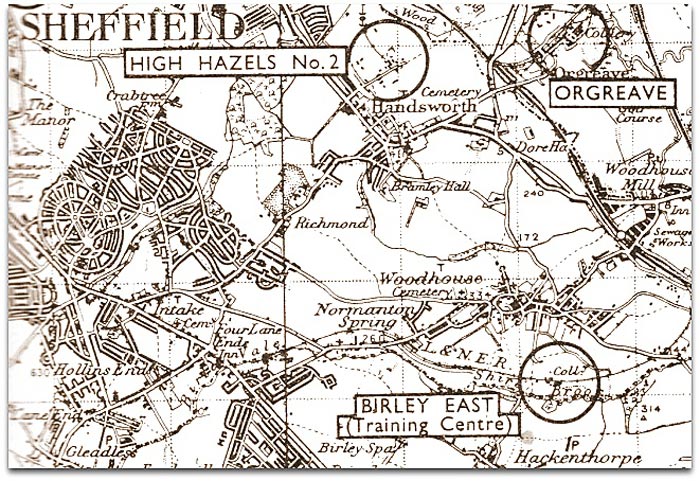
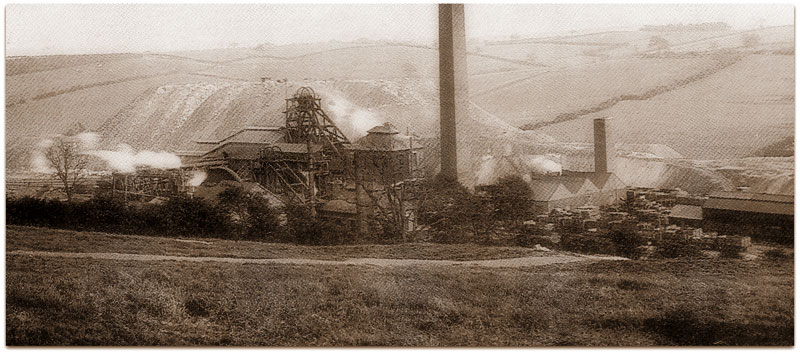
Birley East pit (South Yorkshire) closed on 26th October 1943. However the shafts were left open as the pit was to be used as a Training Centre for entrants to the mines, including Bevin boys and Poles who would then be sent to work at pits in Nottinghamshire and Derbyshire. The mine was sunk in 1888 by the Sheffield Coal Co.
Glapwell
The Top Hard seam workings at Glapwell (Derbyshire) were abandoned in September 1943.
Bretby
The Kilburn seam was abandoned at Bretby (South Derbyshire) in December 1943 in favour of a thicker seam due to wartime measures. At Swadlincote colliery, workings were proved from the old Whitehouse colliery. Two shafts at this colliery were sunk to the Main coal and also worked the Little coal. The third shaft was sunk to the Stockings seam.
Wages Bill For Clifton Colliery
The total wages bill for Clifton colliery (Nottinghamshire) was £184,106 for the 588 workforce plus 17 clerks and salaried staff. Output for the year was 145,006 tons. Output improved to 181,072 tons with 709 men and boys in 1944 and the wage bill increased to £216,481.
Fatal Accidents 1943
- Bolsover, Nathan Douglas (47), Albert Moody (40) and Cyril Kirk (43) all 3 killed in an explosion of firedamp
6 Apr 1943
- Coppice, Harry Bradley (31) run over by tubs 7 Apr 1943
- Coppice, James Fenton (40) shotfiring accident 10 May 1943
- Coppice, Archibald Bestwick (52) died 2 Jul 1943, John Holmes (31) died 2 Jul 1943, Wilfred Amos Noon (25)
died 2 Jul 1943, James Draper (50) died 8 Jul 1943 all 4 caught in a firedamp explosion 28 Jun 1943
- Glapwell, Wilfred Henry Hall (57) fall of roof 29 Sep 1943
- Glapwell, Lewellyn Howarth (47) crushed by tubs 3 Dec 1943
- Shirebrook, Frederick George Brown (34) run over by tubs 12 Aug 1943
- Shirebrook, Harold Buckley (37) fall of coal 14 Aug 1943, died 19 Aug 1943
- Stanley, Charles Bostock (38) shotfiring accident 12 Sep 1943
- Woodside, Joseph Rice (49) fall of roof 25 Sep 1943
- Woodside, Wilfred Marriott (17) caught by a conveyor 28 Sep 1943
Opencast Sites
- Brinsley Moor 23 Jun 1943 – 10 Nov 1943, Coombe 2’ 9” (0.84m), Top Hard 5’ 6” (1.68m) 40,969 tons, the site would be handed back to agriculture in Dec 1946
- Spring Farm Waterloo
- Stanhope Bretby Stanhope seam
- Tupton First Piper seam
- Wollaton Grange Waterloo.
Opencast Output
- North Midlands 1.477m tons
- South Midlands 0.5m tons.
Average wages per shift:
- North Derbyshire 20s 8¾d (£1.43¾)
- South Derbyshire 23s 1¾d (£1.15¾)
- Nottinghamshire 23s 5¼d (£1.17)
- Leicestershire 24s 4½d (£1. 21¾) per shift.
Output for 1943
- North Derbyshire 14.4m tons, with 56 pits using 486 coal cutters, 45 pits using 756 conveyors, 50 gate end loaders, 12 power loaders
- South Derbyshire 1.4m with 7 pits using 55 coal cutters, 82 conveyors, 4 gate end loaders and no power loaders
- Nottinghamshire 16.5m tons with 45 pits, 43 pits using 397 coal cutters, 669 conveyors, 86 gate end loaders,
11 power loaders
- Leicestershire had 13 pits with 131 machines in use producing 4.39m tons.
|


