|
(some links will disappeare with time)
You might need a RealPlayer Plugin for some videos
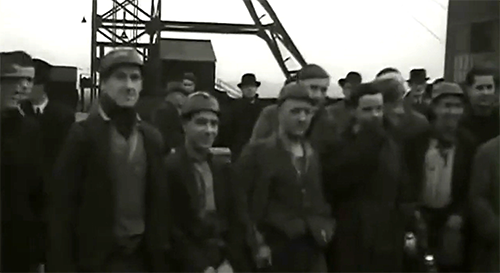
An NCB Documentary Film "The Miner" 1950, B & W, 36 mins "The Miner" (1950) is a 32-minute, black-and-white documentary sponsored by the National Coal Board (NCB). The educational film was primarily designed for British schools to serve as an industry overview and a classroom recruitment tool for older pupils. The film is an excellent introduction to coal mining in Britain, shortly after Nationalisation in 1947, especially for those with little or no knowledge of the subject, hence the reason it was made for schools. Filmed at Hilton Main Colliery, South Staffordshire. It explains the “three shift cycle” of mining in use in the 1950's – Undercutting, Drilling the shot holes, Firing the coal, Hand Loading the coal onto a Face Conveyor and resetting Supports, and finally the Turnover or Advancement of the Conveyor and also Packing - ready for the cycle to begin again. It also includes diagrams showing, in particular, mine ventilation and air flow throughout the mine, including the importance of air locks & air doors. They are also used to show the three shift cycle method of coal mining. Film Overview & Structure: The documentary is framed around an industry undergoing massive post WW2 technological and social transformations. Unlike the NCB's adult-oriented Mining Review cinemagazines, The Miner takes a slower, highly detailed approach across three distinct segments: Part 1: The Shift Underground: This longest section acts as a technical primer. It documents a "typical" miner's shift working underground at the Hilton Main Colliery in Staffordshire, showing the early mechanisation efforts of 1950. Part 2: Leisure and Community: This segment shifts focus above ground, presenting miners as cultured individuals with diverse hobbies, families, and community lives outside of the pits. Part 3: Mining and the Future: The final section urgently outlines the rapid modernisation, restructuring, and social reforms that began when British coal was nationalised in 1947. "Hilton Main Colliery was a deep coal mine in Essington, South Staffordshire, just 3.5 miles north of Wolverhampton. Sunk in 1920 to access reserves for the Holly Bank Coal Company, the pit began full production in 1924, outputting around 350,000 tons annually. It remained the area's largest employer until it closed on January 31, 1969." (wiki) Coal Mining in the UK - Its History & Heritage: This video is for Educational, Historical, and National Heritage purposes. |
|


 Sunshine Silver Mine in Idaho